




What is a Super-Earth?
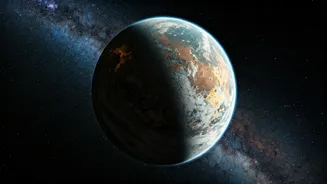
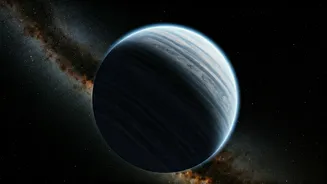
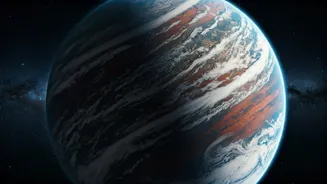
Imagine a planet bigger than Earth, but smaller than Neptune. That is the simple definition of a super-Earth. These planets are not found in our solar system, but they appear to be incredibly common throughout the galaxy. The term refers only to a planet's
size and mass, not whether it is rocky, gaseous, or habitable. They can be anything from 'water worlds' to dense, rocky planets, representing a fascinating class of worlds that scientists are eager to understand. This variety is exactly why they are such compelling targets for powerful new instruments like the James Webb Space Telescope (JWST).
The Curious Case of 55 Cancri e
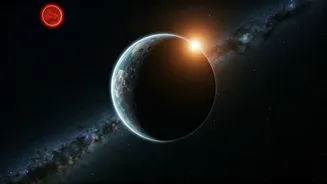
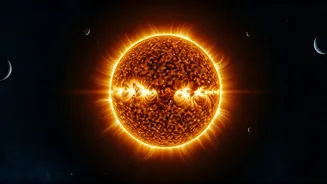
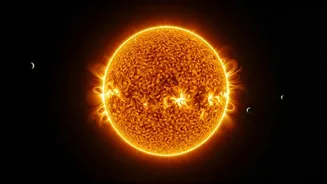
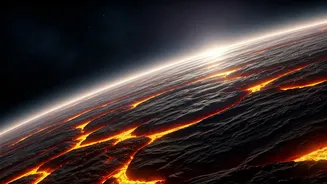
One of the most studied super-Earths is 55 Cancri e, located a relatively close 41 light-years away. It is about twice the diameter of Earth but over eight times more massive, and it orbits its star in a scorching-fast 18 hours. This extreme proximity means its surface is likely a molten ocean of magma. Over the years, theories about its nature have been all over the map. Some speculated it was a 'diamond planet' due to its density and presumed carbon-rich composition. More recent thinking, before the latest data, leaned towards it being a barren rock, its atmosphere long since blasted away by the intense heat and radiation from its parent star.
A Fresh Look from the Webb Telescope
Enter the James Webb Space Telescope. Its powerful infrared instruments have given astronomers their best-ever look at 55 Cancri e, and the findings are transforming our view of the planet. By measuring the subtle changes in light as the planet passes behind its star, Webb was able to take the planet's temperature. The dayside was expected to be around 2,200 degrees Celsius if it were a bare rock. Instead, Webb measured a significantly cooler temperature of about 1,540 degrees Celsius. This surprising finding is strong evidence that heat is being distributed from the dayside to the nightside, something that can really only be done by a substantial atmosphere.
A World Forged by Volcanoes
The old idea that this planet was a bare, airless rock is now being discarded. The new theory, supported by the Webb data, is that 55 Cancri e has a dynamic, secondary atmosphere. This is not the original atmosphere the planet formed with, which would have been stripped away long ago. Instead, this atmosphere is likely being constantly replenished from the inside. Scientists believe the planet's magma ocean is continuously releasing gases like carbon dioxide or carbon monoxide. This outgassing from widespread volcanic activity creates a thick blanket of gas that circulates heat around the planet, explaining the cooler-than-expected temperature reading. It paints a picture of a hellish but geologically active world.
Why One Planet's Atmosphere Matters
This discovery is more than just a fascinating update on one exotic world. It is a landmark moment in the study of rocky exoplanets. It provides the best evidence to date that a rocky planet, even one blasted by its star, can maintain a significant atmosphere. This has huge implications for the search for life elsewhere. Understanding how a planet's geology can create and sustain an atmosphere is a key piece of the puzzle. While 55 Cancri e is far too hot to be habitable, studying its atmosphere provides a natural laboratory for understanding the processes that may have shaped Earth, Venus, and Mars in their early, molten stages.