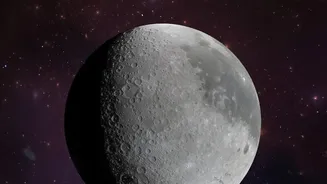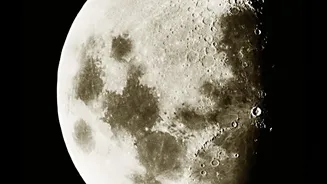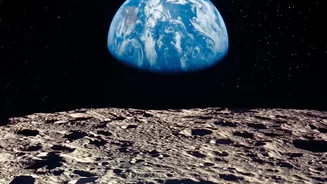





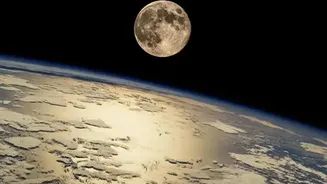


You’ve seen it: a colossal, golden moon hanging just above the horizon, so big it feels like you could reach out and touch it. A few hours later, it's a small, white disc in the sky. So, what happened? The answer is nothing—not to the moon, anyway.
It’s Not the Atmosphere’s Fault
Let's
get one common misconception out of the way first. For centuries, people thought the Earth's atmosphere acted like a magnifying lens for the rising or setting moon. It's a romantic idea, but it’s verifiably false. Photographs taken of the moon at the horizon and at its zenith (its highest point in the sky) show that its size doesn't change. You can even prove this yourself. The next time you see a giant-looking moon, hold a small object like a pea or a pencil eraser at arm's length. You'll find it covers the moon just as completely on the horizon as it does when it's high in the sky, demonstrating that the image hitting your retina is exactly the same size. The illusion isn't out there in the world; it’s inside your head.
Your Brain’s Faulty Distance Calculator
The leading explanation for the Moon illusion is called the 'Apparent Distance Hypothesis'. Think of it this way: your brain has spent a lifetime learning to judge distance based on cues. When you look toward the horizon, you see trees, buildings, and mountains. Your brain knows these objects are far away, so it creates a sense of deep, vast space. When the moon appears in this context, your brain says, 'Wow, that thing is way out there at the far end of all this stuff!' In contrast, the sky directly overhead is an empty void. There are no depth cues, so your brain perceives it as being much closer, like a flattened dome above you. The sky overhead feels near, while the sky at the horizon feels distant.
A Cosmic Case of the Ponzo Illusion
This is where a classic optical trick, the Ponzo illusion, comes into play. Imagine two identical lines drawn on a set of converging railroad tracks. The line closer to where the tracks meet will look longer than the one closer to you. It isn't, but your brain uses the perspective of the tracks to judge size. It reasons that for something to appear that large from so 'far away,' it must be physically huge. The Moon illusion works on the same principle. The horizon is filled with depth cues (like railroad tracks) that tell your brain the moon is very far away. The zenith sky has none. Since the moon's size on your retina is constant, your brain concludes the 'farther' horizon moon must be physically larger than the 'closer' zenith moon to create the same size image. It’s a flawless piece of faulty logic.
Experiments That Break the Spell
The best proof that the illusion originates in our minds comes from experiments that remove the environmental context. One of the simplest is to look at the horizon moon through a cardboard tube. By blocking out the surrounding terrain and isolating the moon, the illusion often vanishes, and the moon immediately 'shrinks' back to its normal perceived size. Another method is to bend over and look at the moon from between your legs. This simple act of inverting the scene disorients your brain's usual processing of the landscape, disrupting the depth cues and diminishing the illusion. These experiments show that when you take away any context your brain uses to judge distance, any size scaling trick it performs disappears.