



Welcome to the Galaxy's Hottest Worlds
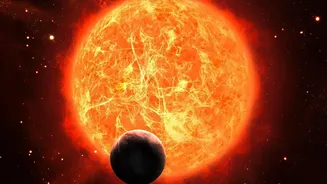
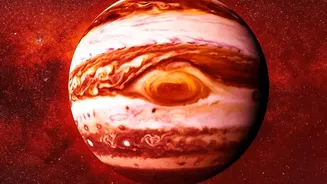
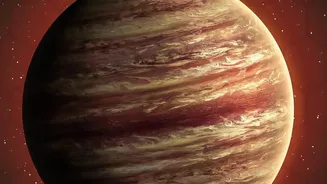
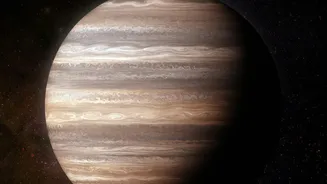
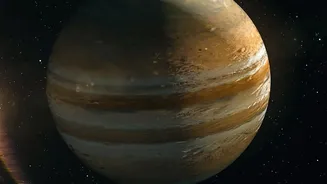
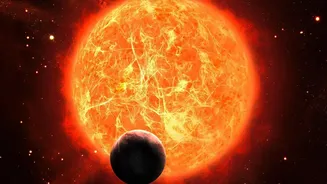
The planets hosting this extreme weather belong to a class called 'ultra-hot Jupiters'. These are gas giants, similar in size to our own Jupiter, but they orbit perilously close to their parent stars. One such world, WASP-76b, is located about 640 light-years
from Earth and completes a full orbit in just 1.8 Earth days. This proximity results in tidal locking, meaning one side of the planet perpetually faces its star, while the other is locked in eternal night. The dayside receives thousands of times more radiation than Earth gets from the Sun, pushing temperatures above 2,400 degrees Celsius — hot enough to vaporise metals. This incredible temperature difference between the blistering day side and the cooler (though still scorching) night side is the engine that drives the universe's most violent weather systems.
When the Forecast Calls for Iron Rain
On the dayside of WASP-76b, the intense heat turns elements like iron not into a solid or liquid, but into a gas. This iron vapour is then swept across the planet by ferocious winds. As the vapour reaches the terminator — the line between day and night — it encounters the much cooler temperatures of the night side, which can be around 1,500 degrees Celsius. This temperature drop causes the gaseous iron to condense back into a liquid, forming droplets. These droplets then fall from the sky as a literal rain of molten iron. Because WASP-76b is a gas giant, it has no solid surface for the iron rain to collect on. Instead, the droplets fall into the deeper layers of the atmosphere until they are heated and vaporised again, continuing the brutal cycle.
Winds Faster Than a Fighter Jet
The extreme temperature gradient between the two sides of these planets creates massive pressure differences, generating winds that are almost incomprehensibly fast. On an exoplanet named WASP-127b, astronomers have measured the fastest jet stream ever recorded, with winds raging around the equator at up to 33,000 kilometres per hour. That's more than 25 times the speed of sound on Earth. For comparison, the fastest winds ever measured in our own solar system, on Neptune, clock in at a relatively tame 1,800 km/h. These supersonic winds are powerful enough to carry the vaporised metals and rocks from the day side to the night side, fuelling the bizarre precipitation cycles. On another world, WASP-121b, winds have been measured at speeds of over 11,000 mph, creating a climate that one scientist described as "like something out of science fiction".
How Telescopes Become Weather Stations
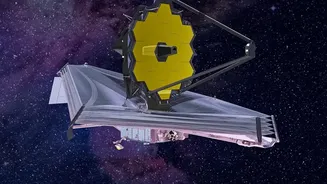
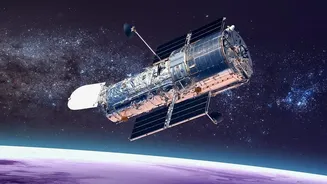
Detecting weather from light-years away requires incredible precision and clever techniques. Astronomers use powerful infrared instruments, like those on the European Southern Observatory's Very Large Telescope and NASA's James Webb Space Telescope (JWST). One primary method is called transit spectroscopy. As an exoplanet passes in front of its star, a tiny amount of starlight filters through the planet's atmosphere. Molecules in the atmosphere absorb specific wavelengths (or colours) of light, leaving a chemical fingerprint. By analysing which colours of light are missing, scientists can identify the elements present, such as iron vapour. In the case of WASP-76b, astronomers detected a strong iron signature as the day side rotated out of view, but saw it disappear as the night side came into view, providing the crucial evidence that the iron was condensing and raining out of the atmosphere.