




Sailing on Beams of Light
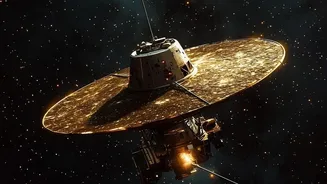
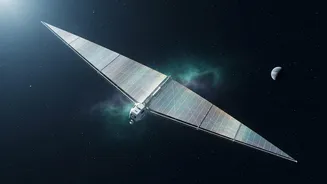
Imagine a sailboat crossing the ocean, its sails catching the wind. Now, replace the ocean with the vacuum of space and the wind with light itself. This is the core idea behind reflective sails. It sounds like science fiction, but it’s based on a real
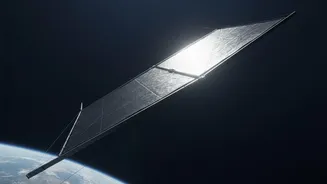
physical phenomenon: light particles, called photons, have momentum. While each photon provides a minuscule push, when billions of them bounce off a massive, ultra-thin, mirror-like sail, the collective effect is a gentle but constant acceleration. Unlike a conventional rocket that fires its engines for a few minutes and then coasts, a sail-powered craft accelerates continuously for weeks, months, or even years.
The Tyranny of Fuel
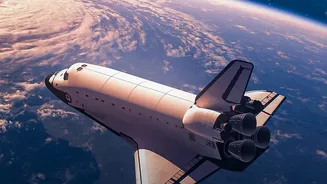
The single biggest problem in space travel is fuel. Most of a traditional rocket's weight is the propellant it needs to lift itself and its payload. This is known as the 'tyranny of the rocket equation.' It severely limits the speed, range, and duration of missions. Reflective sails shatter this limitation because they don’t carry any propellant at all. By leaving the 'fuel' behind—whether it's the sun or a laser on Earth—the spacecraft is significantly lighter and can achieve velocities that are simply impossible for chemical rockets on long-haul journeys. This opens the door to exploring the outer solar system and even the stars beyond in a fraction of the time.
Two Paths to the Stars
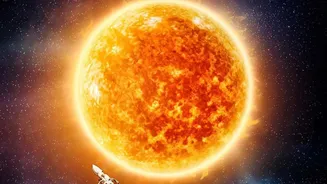
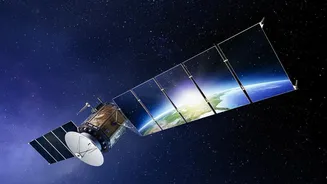
Reflective sail concepts are primarily developing along two parallel paths. The first is the solar sail, which uses the abundant and free photons streaming from our sun. This technology is already being tested. Japan's IKAROS mission flew by Venus in 2010, and The Planetary Society's LightSail 2 successfully demonstrated orbital maneuvering in 2019. More recently, NASA's ACS3 mission successfully deployed its sail in 2024 to test new, stronger composite boom materials. The second, more ambitious path is the laser-pushed lightsail. This concept involves using a powerful, ground-based laser array to propel a tiny probe. The Breakthrough Starshot initiative, for example, aims to use this method to send a 'nanocraft' to our nearest star system, Alpha Centauri, in just over 20 years.
From Test Flights to New Contracts
The promise of this technology is rapidly moving from theory to reality, driving new investment and engineering. NASA's ACS3 mission, which launched in April 2024, is a critical step, proving out the advanced, lightweight booms needed to support truly massive sails. Building on this, in April 2026, NASA awarded a $10.2 million contract to the Colorado-based company Opterus to engineer a deployment system for a solar sail measuring 1,600 square meters—about the size of a hockey rink and 20 times larger than ACS3. This signals a clear strategy to scale up the technology for more demanding deep-space science missions. The market is taking notice, with projections showing the solar sail technology sector growing into a multi-billion dollar industry by the early 2030s.
The Challenges on the Horizon
Despite the immense promise, significant hurdles remain. For solar sails, the sun's push becomes weaker with distance, diminishing as the spacecraft travels into deep space. For laser sails, the challenges are monumental. They require building a laser array with a power output equivalent to hundreds of power plants and designing sail materials that can withstand this intense energy without vaporizing. And for any high-speed interstellar probe, a crucial question remains unanswered: how do you slow down to study your destination when you arrive at a fraction of the speed of light? These are the complex engineering problems that scientists and private companies are now working to solve.