



The Arm's Length Rule
The first step to reducing eye strain is setting the right distance between you and your screen. A simple and effective guideline is the 'arm's length rule'. Sit comfortably and extend your arm straight out in front of you; your fingertips should just
about touch the screen. This distance, typically between 20 to 28 inches (about 50 to 70 cm), allows your eyes to focus without excessive effort. If you find yourself leaning in to read, resist the urge to move the laptop closer. Instead, increase the font size in your device's settings. This simple change ensures you maintain an ergonomic distance that benefits both your eyes and your posture.
Finding the Right Screen Height and Angle
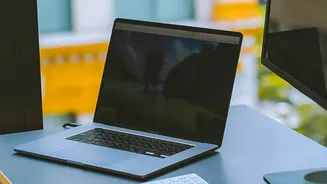
Your screen's position is just as crucial as its distance. For optimal comfort, the top of your laptop screen should be at or slightly below your eye level. This encourages a slight downward gaze of about 15 to 20 degrees, which is a more natural and relaxed position for your eyes and neck muscles. Laptops, by their nature, often cause users to hunch over. To correct this, use a laptop stand or even a stack of books to elevate the screen to the proper height. When you do this, it's best to use an external keyboard and mouse to keep your wrists and arms in a neutral, comfortable position.
Calibrating Your Screen Brightness
A screen that is too bright or too dim can cause significant eye fatigue. The goal is to match your screen's brightness to the ambient light in your room. A quick way to check this is to hold up a piece of white paper next to your screen; if the screen looks like a light source, it's too bright. If it appears grey and dull, it's too dark. In a standard well-lit room, a brightness level between 250 to 350 nits (cd/m²) is often recommended. In a darker environment, you should lower the brightness to between 120 to 180 nits to avoid unnecessary strain. Many modern devices have an auto-brightness feature that can handle this for you.
Master the 20-20-20 Rule
One of the most widely recommended habits for combating digital eye strain is the 20-20-20 rule. The concept is simple: for every 20 minutes you spend looking at your screen, take a 20 second break to look at something at least 20 feet away. This simple exercise allows the focusing muscles inside your eyes to relax, which can help prevent fatigue, dryness, and discomfort. It takes about 20 seconds for your eyes to fully relax and refocus. Set a timer on your phone or computer as a reminder until it becomes a natural part of your workflow.
Minimize Glare and Blink More Often
Glare from windows or overhead lighting can force your eyes to work harder. Position your workstation so that windows are to the side, rather than directly in front of or behind your screen. If you can't move your desk, use blinds or an anti_glare screen protector to reduce reflections. Another simple but often forgotten habit is to blink more. When we stare at screens, our blink rate can drop significantly, leading to dry, irritated eyes. Make a conscious effort to blink fully and frequently. Using over_the_counter artificial tears can also help keep your eyes lubricated and comfortable throughout the day.