








The Limits of Old-School Safety
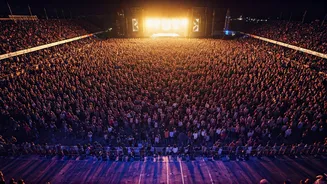
For decades, festival safety relied on a familiar set of tools: security personnel on the ground, static signage, and the occasional blast from a loudspeaker system. While essential, these methods have significant limitations in a sprawling, noisy, and fast-moving
environment. A message over a PA system can be lost in the music, and static signs are useless when a situation changes in an instant. In a large crowd, finding a security guard or a first-aid tent can be a challenge for an attendee in distress. This traditional approach is largely reactive, often addressing problems only after they have begun to escalate. In an era where attendees expect instant information, these analogue methods are no longer sufficient on their own.
The Rise of the Digital Lifeline
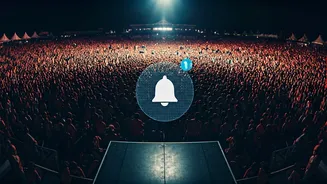
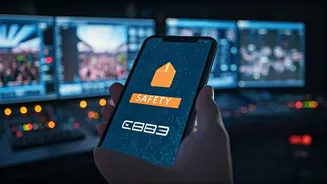
Enter real-time communication. This isn't just one single technology, but a suite of integrated digital tools designed to connect organisers, staff, and attendees instantly. The most visible component is the official festival mobile app. Once considered a simple tool for checking schedules and maps, these apps have evolved into powerful safety platforms. Through push notifications, organisers can send targeted, instantaneous alerts to every attendee who has the app installed. Behind the scenes, specialised event management platforms and push-to-talk apps allow security, medical, and operational teams to coordinate their responses with a clarity that traditional two-way radios can't always provide. These systems create a digital nervous system for the entire event space.
From Weather Alerts to Crowd Control
The practical applications of this technology are game-changing. If a sudden thunderstorm is approaching, organisers can send a mass notification advising attendees to seek shelter and pause performances, preventing panic and ensuring an orderly response. AI-powered surveillance can even monitor crowd density, and if an area near a stage becomes dangerously overcrowded, a push notification can be sent to redirect incoming foot traffic to less congested routes, potentially preventing a dangerous crush. The communication can also be a two-way street. Some festival apps now include an SOS button that allows an attendee to discretely alert security or medical staff, sharing their live GPS location for a rapid response. This feature is invaluable in situations where someone feels unwell, unsafe, or witnesses an emergency.
Enhancing the Overall Experience
While emergency response is the most critical function, real-time communication also contributes to a safer and more pleasant festival experience in more subtle ways. By managing the flow of people, organisers can reduce queue times for everything from entry gates to food vendors and restrooms. A simple notification letting attendees know that a particular bar has no queue can disperse crowds and improve everyone's experience. These apps also serve as a central source of truth, combating the spread of misinformation that can cause confusion or panic on social media. By providing official updates on schedule changes, site logistics, or even lost-and-found information, organisers can build trust and reassure attendees that there is a reliable system in place to look after them.
The Challenges Ahead
Despite its immense potential, this technology is not a silver bullet. Its effectiveness hinges on widespread adoption; attendees must be encouraged to download the festival app and, crucially, enable push notifications. Another significant hurdle is network connectivity. The sheer number of people in one place can overwhelm cellular networks, potentially delaying or blocking crucial alerts. Event organisers are increasingly investing in their own robust Wi-Fi networks to counter this. Furthermore, technology must always be supported by well-trained human staff. An SOS alert is only useful if there is a team ready to respond to it. Real-time communication is a tool to empower on-ground teams, not replace them.