



The Old Blueprint: A Slow Assembly
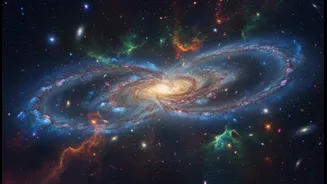
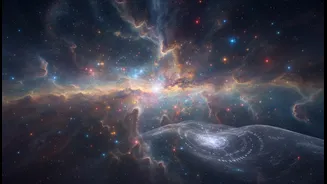
The long-accepted story of how galaxies like our own Milky Way came to be was one of patient, hierarchical growth. The theory proposed that after the Big Bang, small clumps of matter and gas slowly merged, pulled together by gravity. Over vast stretches
of cosmic time, these smaller protogalaxies would collide and combine, gradually building up into the grand spiral and elliptical galaxies we see today. This model suggested a relatively orderly and predictable timeline for the universe. Astronomers expected that when they peered back into the cosmic dawn—the first billion years of the universe's existence—they would find mostly small, primordial galaxies, still in the chaotic process of formation. The giants, it was believed, came much, much later.
A Wrench in the Cosmic Engine
Then came the James Webb Space Telescope (JWST). With its unprecedented power to see the faint, stretched-out light from the dawn of time, it started sending back pictures that didn't fit the established model. Astronomers were shocked to find massive, well-formed galaxies that were far larger and more mature than theories predicted were possible so early in the universe's life. Some of these giants, existing just one or two billion years after the Big Bang, had already mysteriously stopped forming stars, a process known as quenching. This was a major puzzle: how did these galaxies grow so big, so fast, and then suddenly shut down their star-making factories while the universe was at its peak of activity?
Evidence of a Violent Past
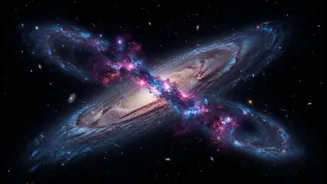
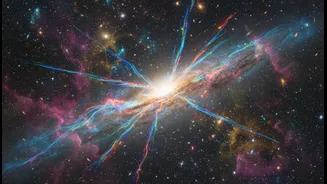
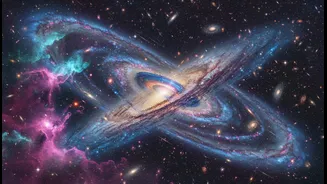
New research provides a compelling answer: violent, large-scale collisions. An international team of astronomers, using deep images from JWST, looked closely at a sample of these early, massive quenched galaxies. On the surface, they appeared calm and orderly. But by using Webb's incredible sensitivity to analyse their structure, scientists found subtle but clear signs of past trauma—faint asymmetries and disturbances hidden in their outer regions. These are the tell-tale scars of a recent, massive merger between two gas-rich galaxies. The simulations match the observations: such a violent collision would drive huge amounts of gas to the galactic centre, triggering a furious burst of star formation that builds up the galaxy's mass quickly. This intense event would then use up or blow away all the remaining gas, effectively quenching the galaxy and halting its growth almost as quickly as it began.
Why Faster Growth Changes Everything
This discovery fundamentally alters our understanding of the cosmic timeline. It suggests that the first massive galaxies weren't built piece by piece over eons, but were forged in dramatic, rapid bursts fueled by cataclysmic collisions. This chaotic, accelerated growth model helps explain the presence of surprisingly mature and massive galaxies in the early universe. It also provides a reason for why they stopped forming stars so abruptly. It implies that the early universe was a far more turbulent and active place than previously imagined, with galaxy formation happening in fast, violent episodes rather than a slow, steady crawl. This new evidence doesn't just affect our knowledge of galaxies; it has ripple effects on our understanding of star formation, the growth of supermassive black holes at galactic centres, and the distribution of heavy elements throughout the cosmos. The story of our cosmic origins, it turns out, is much more dramatic than we ever knew.