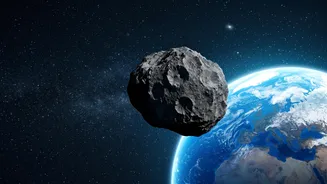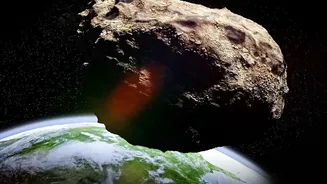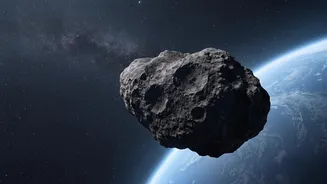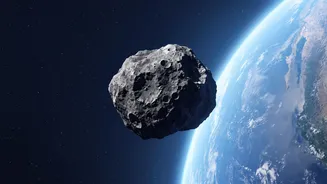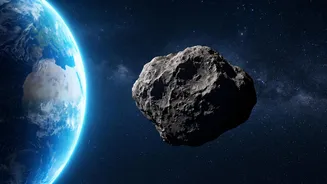


Look up. Our familiar Moon might have a tiny, temporary companion. A new 'mini-moon', designated 2026 QQ8, has been captured by Earth’s gravity. But this visitor won't be a permanent resident. Here’s the science behind its fleeting visit.
A Visitor in Our Cosmic Neighbourhood
First, what exactly
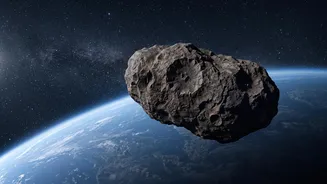
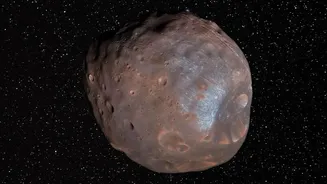
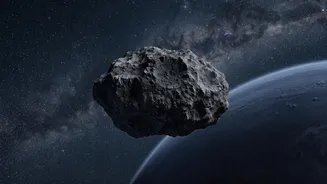
is a mini-moon? Unlike our large, permanent Moon, a mini-moon is a small asteroid that gets temporarily snared by Earth's gravitational pull. Officially known as Temporarily Captured Objects or TCOs, these space rocks are usually just a few metres across—some are no bigger than a car. They come from the vast asteroid belt between Mars and Jupiter or from a group of asteroids closer to us. Finding them is difficult; they are small, fast, and faint. To date, astronomers have only confirmed a handful, including famous past visitors like 2006 RH120 and 2020 CD3. These objects weren't born into orbit around Earth; they are travellers that took a temporary detour.
The Delicate Dance of Gravity
Capturing a mini-moon is a matter of celestial chance, requiring the perfect speed and trajectory. As an asteroid's orbit around the Sun brings it close to our planet, it enters a complex gravitational environment. The combined pull of the Sun, Earth, and our own Moon creates a tricky landscape of pushes and pulls. If an asteroid enters this region, known as Earth's Hill sphere, at a low enough velocity, it can become gravitationally bound to our planet for a while. Think of it like a ball rolling across a bumpy surface; if it rolls into a shallow dip at just the right speed, it can get stuck for a bit before rolling out again. These captures often happen when the asteroid passes through specific points in space, called Lagrange points, where gravitational forces are balanced.
An Unstable and Chaotic Orbit
So, why the short stay for 2026 QQ8? The very same forces that capture a mini-moon also ensure its departure. A mini-moon's orbit is not a stable, predictable loop like that of our main Moon. Instead, it’s a chaotic path, constantly being nudged and perturbed by the gravitational pulls of the Earth, the Moon, and most powerfully, the Sun. These constant tugs make the orbit unstable. A mini-moon might make a few looping passes around our planet, but it's only a matter of time—usually a few months to a year—before a gravitational nudge from the Sun or Moon gives it the slight boost of energy it needs to escape Earth's gravity and continue its journey through the solar system. For example, the mini-moon 2020 CD3 was captured around 2017 and left Earth's orbit in May 2020.
Why These Fleeting Visitors Matter
Though their visits are brief, mini-moons are scientifically priceless. They are essentially pristine samples from the early solar system, delivered right to our cosmic doorstep. Studying them is far cheaper and quicker than sending a mission all the way to the asteroid belt. These objects can tell us what asteroids are made of—whether they are solid rocks or fragile piles of rubble held together by gravity. This knowledge is crucial for understanding how planets formed and for developing planetary defence strategies against larger, more threatening asteroids. Some scientists even view mini-moons as potential stepping stones for future space exploration, possibly providing resources like water ice for missions heading deeper into the solar system.