



The Cosmic Data Deluge
For as long as humans have looked up, astronomy has been about making sense of the stars. But today’s instruments, like the James Webb Space Telescope, and upcoming observatories, such as the Vera C. Rubin Observatory, are creating a data challenge of astronomical
proportions. The Rubin Observatory alone is expected to generate about 50,000 times the amount of information held in the Library of Congress over its ten-year mission. It’s simply impossible for scientists to manually sift through this flood of information. An astronomical image might contain 99% background noise, with the faint signature of a distant galaxy or a transiting exoplanet hidden in the remaining 1%. This is where artificial intelligence moves from a futuristic concept to a present-day necessity.
NASA's New AI Blueprint
Recognizing this challenge, NASA is strategically embedding AI into the core of its scientific process. The agency's Office of the Chief Science Data Officer is spearheading initiatives to develop what are known as AI foundation models. These are large, powerful AI systems trained on vast archives of NASA's scientific data, which can then be adapted for a wide variety of specific tasks with minimal new training. For instance, NASA has already partnered with IBM to develop 'Prithvi', an open-source geospatial AI model trained on decades of Earth satellite data, and 'Surya', a model that monitors the Sun to help predict space weather. The plan is to create similar foundational models for astrophysics, planetary science, and more, effectively building a new digital infrastructure for discovery.
An AI Co-Pilot for Every Scientist
So, what does this mean for the daily work of an astronomer? The goal isn't to replace human scientists, but to augment their abilities. David Salvagnini, one of NASA's key data and AI leaders, has noted that AI should be seen as a tool to make work easier and more efficient. These AI systems act as tireless assistants, capable of performing tasks that were previously incredibly time-consuming or outright impossible. They can scan millions of images to classify galaxies with 98% accuracy, identify the tell-tale dimming of a star that indicates a passing exoplanet, or flag an unusual anomaly in a dataset that might be a completely new phenomenon. This frees up human researchers to focus on the bigger picture: interpreting results, asking new questions, and pursuing the creative leaps of insight that lead to true breakthroughs.
Beyond Just Finding Planets
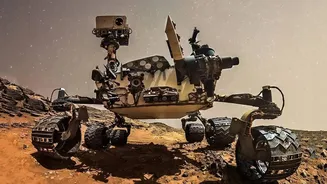
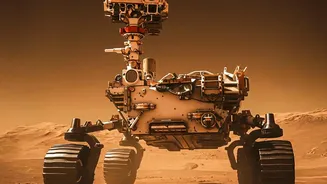
The applications of AI in astronomy extend far beyond data classification. AI is becoming integral to the act of observation itself, with smart systems capable of autonomously scheduling telescope time to optimize for weather and scientific priorities. AI algorithms are also helping to operate spacecraft more efficiently, like the Perseverance rover on Mars, which uses autonomous navigation to traverse hazardous terrain far from Earthly contact. Looking forward, AI could even allow operators to interact with satellites using natural language, simply asking a spacecraft for a status update. The technology is also being used to sharpen our view of the cosmos, as demonstrated when an AI technique was used to dramatically improve the first-ever image of a black hole.
The Future of Accidental Discovery
Perhaps the most exciting prospect is AI's potential to find the 'unknown unknowns'. Many of history's greatest astronomical discoveries were accidental, found by researchers who noticed something unexpected while looking for something else. In a sea of data, AI is uniquely equipped to spot these anomalies. By training AI to find anything that deviates from the norm, scientists can systematically hunt for novel cosmic events, objects, or physical laws. This marks a shift from searching for what we expect to find, to being able to efficiently identify what we never thought to look for. This AI-driven approach is already bearing fruit, helping to uncover hundreds of cosmic anomalies in archived data from the Hubble Space Telescope.