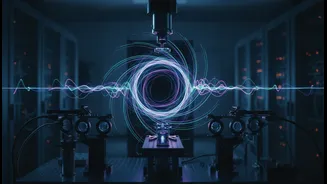









What on Earth is an Optical Skyrmion?
Imagine a tiny, self-contained whirlpool, but made of light instead of water. That's the simplest way to think about an optical skyrmion. It's a remarkably stable, particle-like pattern formed by twisting the properties of light, like its polarization
and phase. First theorized in particle physics in the 1960s and later observed in magnetic materials, the concept has now jumped to the world of optics. Researchers have found ways to sculpt light beams into these intricate, nanoscale knots that don't easily unravel. This stability, what scientists call 'topological protection', means they are resistant to disturbances, a highly desirable trait for carrying information.
From Magnetic to Light-Based Systems
The idea isn't entirely new; its cousin, the magnetic skyrmion, is already a hot topic in materials science for its potential in creating ultra-dense, low-power memory. However, creating and manipulating these magnetic structures has its challenges. The leap to optical skyrmions, first demonstrated around 2018, was a game-changer. Light-based systems offer fundamental advantages over electronic ones: light is massless, immune to electromagnetic interference, and, of course, travels at the fastest possible speed. By encoding information in the stable structure of a light pattern rather than a flow of electrons, we could open a new frontier in processing and transmitting data.
The Promise of Light-Speed Computing
So, what could this technology actually do? The potential applications are vast. For data storage, their tiny size and robustness could lead to memory systems far denser and more durable than anything we have today. In computing, because these are structures of light, they could be manipulated at incredible speeds, paving the way for all-optical processors that perform calculations much faster and with less energy consumption and heat than current electronics. This could be transformative for data centers, artificial intelligence, and high-performance computing, which are all increasingly bottlenecked by power consumption and data transfer speeds. Some researchers even envision using the unique topological number of each skyrmion to perform complex integer arithmetic passively, unlocking a new form of digital computing.
Beyond Raw Speed and Storage
The potential of optical skyrmions extends beyond simply making things faster. Their unique properties could enable entirely new types of technology. For instance, their stability makes them ideal candidates for building qubits, the fundamental units of quantum computers, which are notoriously fragile. They could also revolutionize secure communications, offering a way to transmit information with unprecedented capacity and security. Furthermore, the techniques used to observe skyrmions are pushing the boundaries of high-resolution imaging, allowing scientists to see details far smaller than the wavelength of light itself, which could have knock-on effects in fields like materials science and biology.
The Long Road from Lab to Laptop
Despite the immense promise, it's important to keep expectations grounded. Research into optical skyrmions is still in its early days. While scientists are making incredible discoveries, moving from fundamental physics to applied engineering is a massive leap. Key challenges remain, including developing reliable, scalable methods for creating, controlling, and reading these light structures on demand. Encouragingly, recent breakthroughs have shown that skyrmions can be created using surprisingly simple methods, such as shining a laser at a tiny disc, which could make the technology more accessible for researchers worldwide. However, you won't be finding a skyrmion-powered smartphone on shelves next year. This is a long-term vision for the future of computing architecture.