




How do you move, eat, or sense the world without a brain? For us, it’s impossible. But for jellyfish, some of Earth’s most ancient animals, it’s just another day in the ocean. They are a living testament to an alternate evolutionary path.
Life Without a Command Centre
When we think
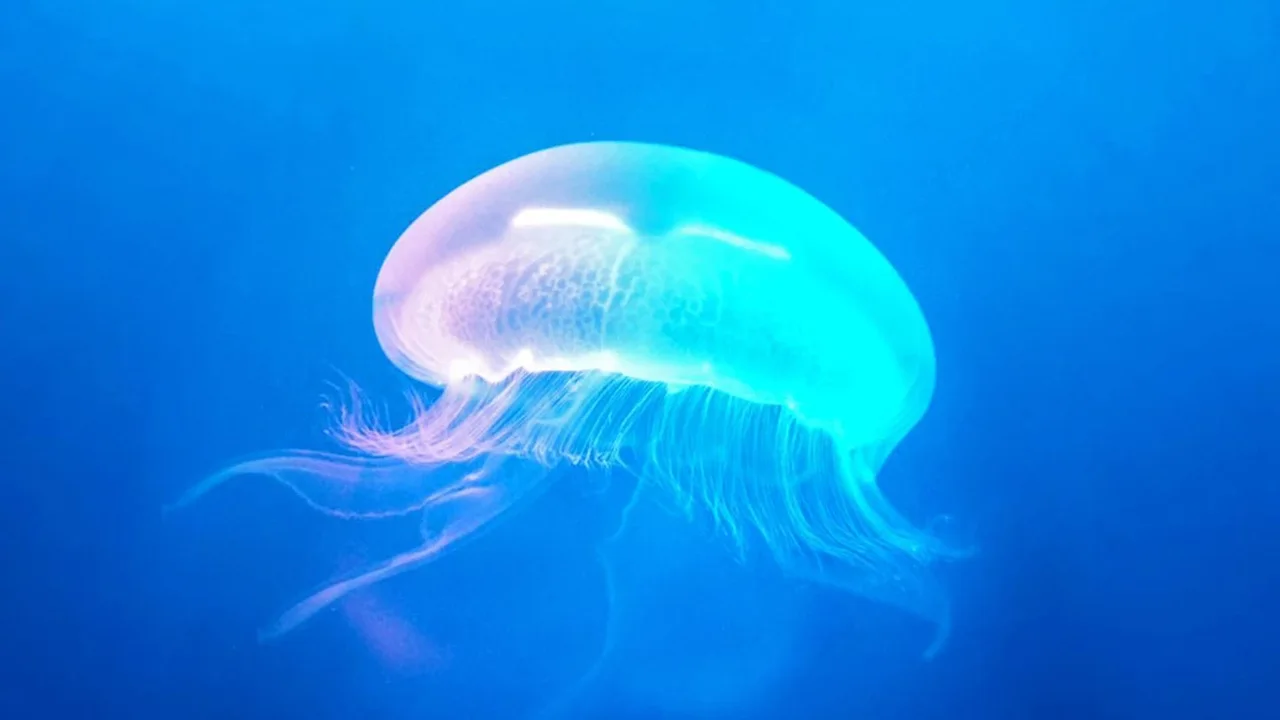
of a nervous system, we imagine a brain as the central command, sending signals down a spinal cord to the rest of the body. Jellyfish throw this model out the window. They don’t have a brain, heart, bones, or blood. Instead of a single, centralised control unit, they operate using a 'nerve net'. This is a diffuse mesh of interconnected neurons spread throughout their bodies, particularly in their thin outer layers. This decentralised system means they aren't 'brainless' in the sense of being unresponsive; they're just wired differently. This network allows them to react to their environment through reflexes, coordinating everything from swimming to feeding without needing a central processor to make every decision.
A Web of Distributed Intelligence
The nerve net is a masterpiece of biological efficiency. Because the neurons are spread out, different parts of a jellyfish can react to stimuli locally. If a tentacle touches prey, the stinging cells in that area can fire without waiting for a signal to travel to a brain and back. This makes their responses incredibly fast and automatic. Some jellyfish species even have multiple, parallel nerve nets. For example, one network might control the rhythmic pulsing of the bell for swimming, while another, more diffuse net handles other behaviours like feeding or turning. This separation of duties shows a surprising level of organisation, proving that a centralised 'boss' isn't the only way to manage a complex system.
The Sensory Hubs: Rhopalia
While the nerve net is decentralised, it's not without its own form of coordination. Along the edge of their bell, many jellyfish have small, club-shaped sensory structures called rhopalia. These can be thought of as mini-hubs that bundle together different sensory organs. A single rhopalium can contain simple eyespots (ocelli) that detect light, gravity-sensing crystals called statocysts to help them stay upright, and chemosensory cells to detect chemical cues in the water. The box jellyfish takes this to an extreme, possessing four rhopalia that contain a total of 24 eyes, some of which are complex enough to form images. These rhopalia feed information into the nerve net, acting as pacemakers to control the speed of swimming and helping the jellyfish navigate its world.
Proof of Unexpected Complexity
The abilities of these brainless wonders are startling. Recent research has shown that some box jellyfish can learn from experience—a process called associative learning. In experiments, they learned to avoid colliding with certain patterns on the walls of their tank, a behaviour previously thought to require a complex brain. The study suggested that this learning happens within the rhopalia, which act as visual processing centres. Furthermore, scientists have discovered that some jellyfish even sleep. The upside-down jellyfish, Cassiopea, shows periods of reduced activity at night and becomes sluggish the next day if deprived of this rest. This discovery suggests that sleep is an ancient behaviour that may have evolved even before central nervous systems did.
What Jellyfish Can Teach Us
Studying the jellyfish nervous system offers profound insights into the evolution of life. It shows that there are multiple ways to build an effective nervous system and that complex behaviours don't always require a centralised brain. This principle of decentralised control is incredibly relevant to modern fields like computer science and robotics. Engineers look to systems like the nerve net for inspiration when designing distributed networks that can function without a single point of failure. By understanding how these ancient creatures thrive, we not only learn about the origins of our own biology but also discover new models for building resilient and efficient technologies.