




1. Seated Cat-Cow
This classic yoga pose, adapted for your chair, is excellent for improving spinal flexibility and relieving tension. Sit at the edge of your chair with your feet flat on the floor and hands on your knees. On an inhale, arch your back, lift your chest,
and look slightly upward (Cow Pose). On your exhale, round your spine, tuck your chin to your chest, and gently pull your navel inward (Cat Pose). Moving with your breath, flow between these two positions for 8-10 repetitions to gently awaken and mobilize your entire spine.
2. Thoracic Extension Over Chair
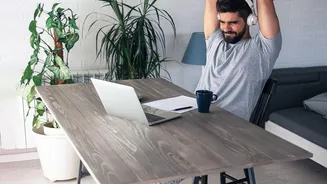
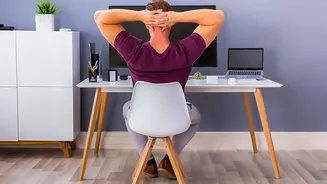
This move directly counteracts the slumped-forward posture that causes so much upper back stiffness. Sit tall in your chair and scoot forward slightly. Clasp your hands behind your head to support your neck, keeping your elbows wide. Gently lean back over the top of your chair, allowing your upper back to arch. Focus on opening your chest and breathing into the stretch. Hold for 15-20 seconds, take a deep breath, and return to the starting position. Repeat this 3-5 times to help restore the natural curve of your upper back.
3. Shoulder Blade Squeeze
This simple but powerful exercise strengthens the key postural muscles between your shoulder blades, helping you sit upright more naturally. While sitting tall with your arms relaxed at your sides, imagine you are trying to hold a pencil between your shoulder blades. Squeeze them together and down, being careful not to shrug your shoulders up toward your ears. Hold the squeeze for 5-10 seconds and then release. Aim to perform 10-15 repetitions. You can do this discreetly while on a call or reading an email.
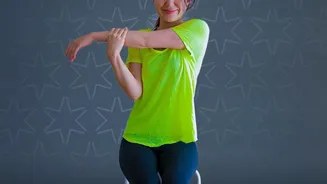
4. Cross-Body Shoulder Stretch
Tightness in the shoulders often contributes to upper back pain. This stretch targets the muscles around the shoulder joint. Bring your right arm across your chest at about shoulder height. Use your left arm to gently deepen the stretch by pressing on your upper right arm. Keep your shoulder relaxed and down, away from your ear. You should feel a stretch in the back of your right shoulder. Hold for 20-30 seconds before switching to the left arm. Repeat on both sides two to three times.
5. Chin Tucks
Forward head posture, or 'text neck', is a major contributor to upper back and neck strain. Chin tucks help correct this by strengthening deep neck flexor muscles. Sit up straight and look directly ahead. Without tilting your head up or down, gently guide your head backward, as if you are trying to make a double chin. You should feel a stretch at the base of your skull and an activation in the front of your neck. Hold for 5 seconds and release. Repeat 10 times to help reset your head and neck alignment.
6. Overhead Stretch with Side Bend
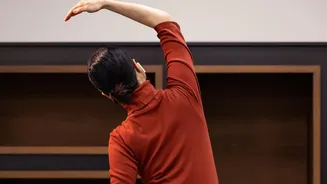
This movement lengthens the sides of your body and the muscles connecting your ribs and shoulders. While seated, interlace your fingers and push your palms up toward the ceiling, straightening your arms as much as is comfortable. After a deep breath, gently bend your torso to the right, feeling a stretch along your left side. Hold for 15 seconds, return to the center, and then repeat on the left side. This not only stretches your lats and obliques but also encourages deeper breathing.
7. Seated Spinal Twist
Rotational movements are crucial for a healthy, mobile spine, yet they are often neglected during the workday. Sit tall with your feet flat on the floor. Gently twist your torso to the right, placing your left hand on your right knee and your right hand on the back or arm of the chair to guide the stretch. Turn your head to look over your right shoulder. Hold for 15-30 seconds, breathing evenly, and then slowly return to the center and repeat on the other side. This helps relieve stiffness in the mid-back and improves flexibility.