





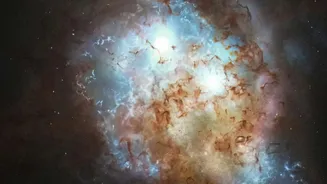
What is This 'Dark Energy'?
Imagine throwing a ball into the air. You expect gravity to pull it back down. Now imagine that ball suddenly shooting upwards faster and faster on its own. That’s essentially what our universe is doing. For billions of years after the Big Bang, the expansion
of the universe was slowing down, just as expected. Then, about five billion years ago, something changed, and the expansion began to speed up. 'Dark energy' is the placeholder name for whatever is causing this cosmic acceleration. It doesn't interact with light, so we can't see it directly. We only know it exists because we can observe its effect on galaxies, pushing them apart at an ever-increasing rate. It’s a profound puzzle, because its existence suggests something fundamental is missing from our theories of physics.
Introducing the CHIME Telescope
Enter the Canadian Hydrogen Intensity Mapping Experiment, or CHIME. Located in British Columbia, Canada, CHIME is a radio telescope with a unique design. It looks less like a traditional satellite dish and more like four giant metal half-pipes, each 100 metres long. Unlike other telescopes that have moving parts to track objects, CHIME is stationary. It uses the Earth's rotation to scan the entire northern sky every single day. Its primary mission was designed with one grand goal in mind: to create a three-dimensional map of the universe and measure the history of its expansion more precisely than ever before, in hopes of finally understanding dark energy.
Listening for Ancient Hydrogen
So how does a telescope help solve the mystery? CHIME isn't looking for visible light from stars. Instead, it’s listening for the faint radio signals emitted by neutral hydrogen, the most abundant element in the cosmos. This hydrogen gas acts as a cosmic tracer, revealing how matter was distributed across vast stretches of space billions of years ago. By mapping this hydrogen, scientists can look for the signature of something called Baryon Acoustic Oscillations (BAO). These are essentially fossilised sound waves from the very early universe that created gigantic, spherical patterns in how matter is spread out. These patterns have a standard size, which astronomers can use as a 'cosmic ruler' to measure how the universe has expanded over different epochs.
A Major Breakthrough, But Not the Final Answer
Recently, the CHIME collaboration announced a major milestone. For the first time, they detected the large-scale structure of ancient hydrogen using only CHIME's own data, without needing to cross-reference it with other, more expensive galaxy surveys. Using data from 2019, they successfully detected a signal from hydrogen when the universe was about 5 billion years old. This proves that their 'hydrogen intensity mapping' technique works and is a powerful, faster, and cheaper way to map huge volumes of the universe. However, this achievement is a crucial proof-of-concept, not the final answer on dark energy. The result does not yet measure dark energy directly but demonstrates that the method designed to do so is sound.
Why the Mystery Continues
Dark energy remains a puzzle because every potential explanation is stranger than the last. One idea is that it is a 'cosmological constant' — an intrinsic energy of empty space itself. Another theory is that it is a new, dynamic energy field that could be changing over time. Recent hints from other surveys suggest dark energy might be evolving, possibly growing weaker, which would have profound implications for the fate of the universe. CHIME's new ability to independently map the expansion history will be a vital tool in testing these competing theories. By creating a detailed history of cosmic expansion, scientists hope to see whether the 'push' from dark energy has been constant or if it has changed. Answering this is the next great frontier.