






Understanding the Enemy: Light Pollution
The biggest obstacle between you and a star-filled sky is light pollution. Artificial light from streetlights, buildings, and cars creates a 'skyglow' that washes out all but the brightest celestial objects. Most major Indian metros like Delhi, Mumbai,
and Bengaluru are rated as Class 8 or 9 on the Bortle scale, a nine-level system that measures sky brightness. In a Class 8 or 9 sky, the Milky Way is completely invisible, and only the Moon, planets, and a few dozen stars can be seen. To see more, you need to find a location with a lower Bortle number, which means a darker sky.
Your Best Tool: The Light Pollution Map
Your quest for darkness begins online. Websites like lightpollutionmap.info are invaluable tools for stargazers. These interactive maps use satellite data to show the intensity of light pollution across the globe. Look at your city on the map, and you will see a bright core of red, orange, or white (high Bortle classes). Your goal is to travel away from this core into the green, blue, or grey zones, which represent darker skies (lower Bortle classes). Even driving an hour or two away from the city centre can dramatically improve your view by placing you in a Bortle Class 4 or 5 zone, where the Milky Way might become faintly visible.
Locating Saturn: When and Where to Look
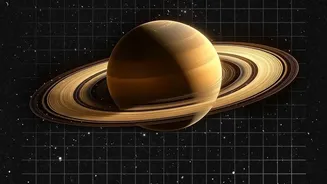
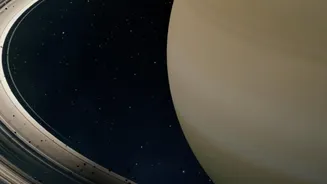
October 2026 is an excellent time for viewing Saturn. On October 4, the planet reaches 'opposition', which means Earth passes directly between Saturn and the Sun. This makes Saturn appear at its biggest and brightest for the year, rising around sunset and staying visible all night long. To the naked eye, it will look like a bright, steady, pale-yellow point of light. To find it, look for the large, four-star pattern known as the Great Square of Pegasus in the eastern sky after dark; Saturn will be visible below it. While you can see the planet without aid, its famous rings are only visible through binoculars or a telescope. Even a small telescope with 25-50x magnification can reveal the rings as a distinct structure.
Essential Apps for the Stargazer
Once you've picked a spot, your smartphone can become a powerful guide. Stargazing apps like SkyView or Star Tracker use your phone's sensors to identify stars, constellations, and planets in real-time when you point it at the sky. Stellarium Mobile is another excellent option, offering a highly detailed sky map that can help you plan what you want to see. For those interested in a more India-centric view, the 'Bhagol: Indian Sky Map' app shows the sky using constellations and terminology from Indian astronomical traditions, such as the 27 nakshatras.
Planning Your Night Out
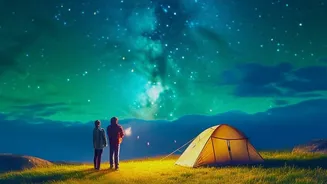
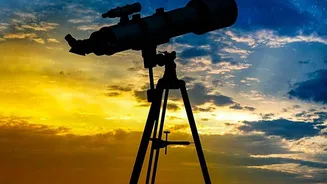
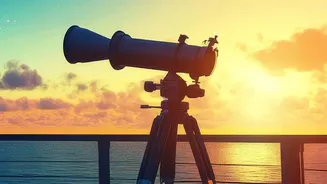
Before you leave, check two things: the weather forecast and the Moon phase. A clear, cloudless sky is obvious, but the Moon is just as important. A bright full moon acts like a natural form of light pollution, washing out fainter stars. The best time for stargazing is during the new moon phase. Pack accordingly for your trip. Bring comfortable seating, warm layers of clothing as nights can get cold, and some snacks and water. For viewing, a pair of binoculars is a great start. If you have a telescope, allow it to cool down to the outside temperature for about 30-60 minutes for the best, sharpest views. Finally, bring a red-light torch instead of a white one; red light is less harsh and helps preserve your night vision, which takes about 20-30 minutes to fully adapt to the dark.