



The Universe’s Ultimate Mystery
First, a quick refresher. Black holes are regions of spacetime where gravity is so intense that they are completely inescapable. The boundary marking this point of no return is called the event horizon. For decades, scientists accepted that black holes were
just that—black. But in 1974, the legendary physicist Stephen Hawking proposed a revolutionary idea. He suggested that due to subtle quantum effects at the event horizon, black holes should actually emit a faint glow of particles, now known as Hawking radiation. This would mean black holes aren't completely black and can, over unimaginable timescales, evaporate. The problem? This radiation is predicted to be so incredibly weak that it's impossible to detect from actual black holes with our current technology, as it would be drowned out by the background radiation of the universe.
Enter the Analogue Black Hole
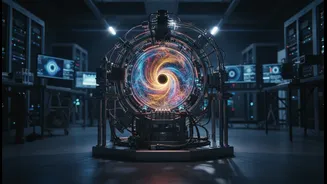
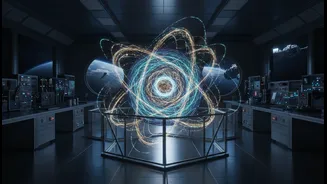
If you can't go to the mountain, you bring the mountain to you. Or in this case, you build a miniature, metaphorical version of it in a lab. This is the central idea behind 'analogue gravity'. Scientists aren’t creating tiny, dangerous black holes. Instead, they are building systems that mimic the one crucial feature they want to study: the event horizon. The concept, first proposed by physicist William Unruh, uses a simple analogy. Imagine a fish swimming in a river that flows faster and faster until it becomes a waterfall. At a certain point, the water is flowing faster than the fish can swim. That point is the fish’s ‘event horizon’; once crossed, it can’t go back upstream. Analogue black holes work the same way, but instead of fish and water, they use waves and different types of flowing media.
How to Build a Black Hole on a Benchtop
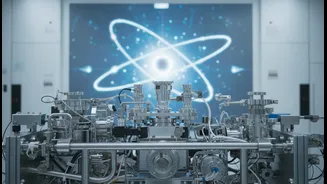
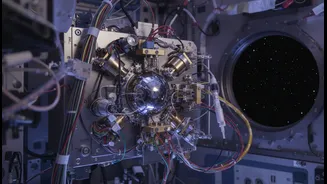
Researchers have devised several ingenious ways to create these analogues. One early method involved creating a vortex in a large tank of water, much like a bathtub drain. Waves on the water's surface act like light, and the point where the water flows faster than the waves can travel acts as a horizon. Another, more precise method uses something called a Bose-Einstein condensate (BEC), a state of matter where thousands of atoms are cooled to near absolute zero and behave like a single quantum entity. By using lasers, scientists can make this ultracold gas flow, creating a region where the flow is faster than the speed of sound within the gas—a sonic event horizon. A third approach uses pulses of laser light inside optical fibres to create a disturbance in the glass that acts as a moving event horizon for other light signals.
Searching for the Glow
The primary goal of these experiments is to see if these lab-made event horizons also produce an analogue of Hawking radiation. Instead of particles, these systems would emit faint sound waves (phonons) or light waves (photons). Observing this would be a stunning confirmation of Hawking's theory, showing that the phenomenon is a fundamental consequence of having an event horizon, regardless of whether it’s made by gravity or a tank of water. And remarkably, scientists have succeeded. Experiments, most notably those led by physicist Jeff Steinhauer using Bose-Einstein condensates, have observed spontaneous quantum fluctuations that strongly resemble the expected Hawking radiation. They have even shown the quantum entanglement between the particle pairs that are created, a key feature of the theory. While debates continue in the scientific community, the evidence is mounting.
Why It Matters for Us on Earth
This research isn't just about confirming a 50-year-old theory. It’s about tackling one of the biggest challenges in all of science: unifying general relativity (the theory of gravity and the very large) with quantum mechanics (the theory of particles and the very small). Black holes are the one place in the universe where these two theories must meet. Analogue experiments provide a unique, controllable testbed to explore this exotic intersection. They allow us to probe the fundamental nature of spacetime and quantum fields in ways that would otherwise be impossible. This work is a testament to scientific creativity, showing how a tabletop experiment in a quiet lab can shed light on some of the most violent and mysterious objects in the entire cosmos.