


A Celestial Meeting of Minds
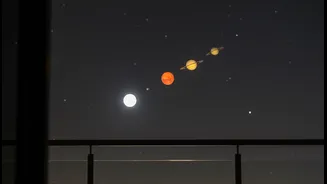
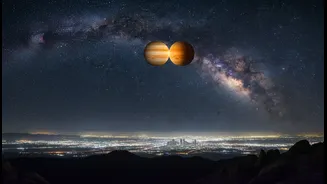
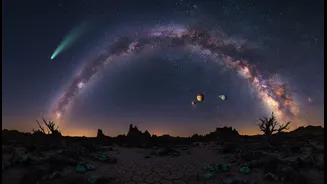
First, let's talk about what a planetary conjunction is. In simple terms, it's an event where two or more planets appear to be very close together in our night sky. Of course, they aren't physically close; they are still millions of kilometres apart in their
own orbits. It's all about perspective from our vantage point on Earth. When bright planets like Venus and Jupiter team up, it can be a spectacular naked-eye event. These alignments happen because all the planets orbit the Sun on a relatively flat plane called the ecliptic. Think of it as several runners on different tracks of a stadium; occasionally, from the spectators' view, they line up perfectly. These events offer a fantastic opportunity for even casual skywatchers to identify planets.
The Astronomer's Unseen Enemy
The biggest challenge for any astronomer, from a professional at a large observatory to someone on their balcony, is the Earth's atmosphere. While it's essential for life, it can wreak havoc on light travelling from space. The main culprit is atmospheric turbulence. Pockets of air at different temperatures are constantly mixing, which bends and distorts the light passing through them. This is what causes stars to twinkle. Astronomers have a term for the stability of the atmosphere: 'seeing'. Good seeing means the air is calm and stable, providing sharp, steady views. Poor seeing, caused by a lot of turbulence, makes celestial objects appear blurry or shaky, as if you're looking at them through shimmering water.
How Rain Washes the Sky
Here's where the rain comes in. One of the primary ways rain enhances views is by physically cleaning the air. Our atmosphere is full of tiny suspended particles called aerosols, which include dust, pollen, soot, and other pollutants. These particles scatter light, which can create a general haze that reduces the contrast and clarity of the night sky. Rain is nature's laundry cycle. As raindrops fall, they collide with and capture these aerosol particles, a process called 'washout' or 'scavenging'. This process effectively pulls the pollutants out of the air and deposits them on the ground, leaving behind a much more transparent atmosphere. After a good downpour, the air is literally cleaner, allowing more starlight and planet-shine to reach your eyes unimpeded.
The Calm After the Storm
But it's not just about clean air; it's also about calm air. The 'settling' part of the headline refers to a reduction in atmospheric turbulence. During the day, the ground heats up and radiates that heat, creating rising currents of warm air (convection) that mix with cooler air above. This mixing is a major source of poor 'seeing'. A rain shower, particularly the kind that accompanies a cold front, can dramatically change this dynamic. The rain cools the ground and the air layers closest to it. This can lead to a more stable atmospheric condition where the layers of air are more uniform in temperature, reducing the turbulence that makes stars twinkle and planets shimmer. The atmosphere becomes less like a boiling pot of water and more like a still pond, allowing for a much steadier view.
Your Balcony, A Front-Row Seat
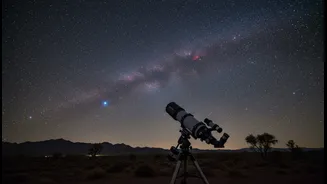
So, when you combine these two effects, you get a perfect recipe for stargazing. The rain has washed the haze-causing particles from the air (improving transparency), and the subsequent cooling has stabilised the air, reducing the shimmer and blur (improving seeing). This means the faint light from distant planets appears sharper and more defined. For a conjunction, where you want to distinguish two close points of light, this clarity is crucial. To make the most of it, wait for the clouds to fully clear after a rain shower. Find a spot with an unobstructed view of the right part of the sky, let your eyes adjust to the dark for about 15-20 minutes, and avoid looking at your bright phone screen. Even a simple pair of binoculars can dramatically enhance your view of a planetary pairing.