





Earth's Cautionary Tale Next Door
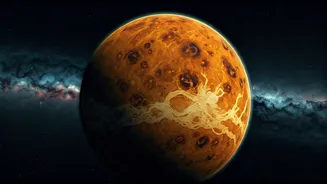
Venus and Earth started as planetary siblings, similar in size and composition. But their paths diverged dramatically. Today, Venus is the hottest planet in our solar system, with a surface temperature that can melt lead and a crushing atmosphere made
of 96% carbon dioxide. Scientists believe Venus is a natural laboratory for understanding the greenhouse effect at its most extreme. At some point, heat-trapping gases in its atmosphere created a feedback loop, boiling away its oceans and turning it into the inhospitable world it is today. This history makes Venus a crucial case study, offering a stark warning of how dramatically a planet's climate can change and providing invaluable data for our own climate models on Earth.
Introducing the Shukrayaan-1 Mission
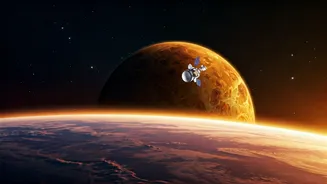
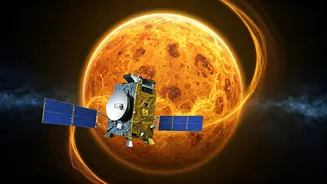
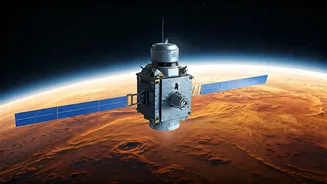
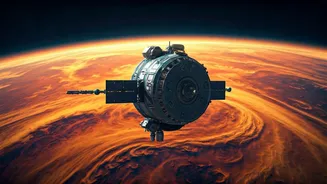
To unlock these secrets, the Indian Space Research Organisation (ISRO) is planning its first-ever mission to Venus, named Shukrayaan-1 (from the Sanskrit for 'Venus Craft'). Officially approved by the Indian government, this orbiter mission is designed to conduct a comprehensive study of the planet from above. It will investigate Venus's surface and subsurface, analyse its complex atmosphere, and study the interaction between the planet and the solar wind. Though the mission timeline has been adjusted, with a launch now targeted for March 2028, its core objectives remain a top priority for Indian planetary science. The spacecraft will be launched aboard India's powerful LVM-3 rocket.
A Flying Laboratory for Climate Science
Shukrayaan-1 will carry a suite of scientific instruments designed to peer beneath the planet's thick, reflective clouds of sulfuric acid. Key payloads include a high-resolution synthetic aperture radar to map the surface and subsurface geology, which is impossible with standard optical cameras. Other instruments will study the atmospheric composition, wind speeds, and chemical processes. By gathering data on Venus's extreme greenhouse effect, scientists hope to refine the models used to predict climate change on Earth. Understanding why a planet so similar to our own became so different will provide critical insights into the long-term stability of Earth's own climate and atmosphere.
Why the Mission Matters for India
For India, a nation on the front lines of climate change, the scientific returns from Shukrayaan-1 could be immensely valuable. Better climate models, informed by Venusian data, can lead to more accurate predictions of monsoon patterns, heatwaves, and long-term environmental shifts. The mission is not just a quest for knowledge but a strategic investment in securing India's future. It builds on the legacy of the Mars Orbiter Mission (Mangalyaan) and Chandrayaan missions, further cementing ISRO's reputation as a world-class space agency capable of complex interplanetary journeys. Furthermore, the project fosters international collaboration, with payloads from countries like Sweden and Russia set to be included, and stimulates domestic technological development.