


A Cosmic Cold Case
The story begins with a white dwarf star named HS 0209+0832, located about 270 light-years from Earth. More than two decades ago, in 1999, data from the Hubble Space Telescope revealed about 100 mysterious chemical signatures in the star's atmosphere
that astronomers couldn't identify. For years, this cosmic puzzle lay dormant in the archives. Now, a team of researchers led by the University of Warwick has revisited this old data with new tools, finally cracking the case and revealing a startling possibility.
The Niobium Clue
The key to the mystery turned out to be an element called niobium. The team identified that the strange signals in the white dwarf's atmosphere were caused by heavy elements like copper, zinc, and, most surprisingly, niobium. This was the first time niobium had ever been detected in a white dwarf's atmosphere, and it was present at levels more than 1,000 times higher than what is found in our Sun. This chemical cocktail is highly unusual. White dwarfs are often 'polluted' by rocky asteroids they consume, which typically leaves traces of elements like iron and silicon. The elements seen around HS 0209+0832 told a very different story.
Forged in Stellar Death
Heavy elements like niobium are not created during a star's normal life. Instead, they are forged through a specific nuclear reaction called the 's-process', which occurs only inside bloated, dying stars. Finding such a strong signature of these elements meant the material polluting the white dwarf couldn't have come from a normal, 'first-generation' planet—one that formed when the star was originally born. This chemical fingerprint strongly suggests the material came from the star itself, ejected during its violent death throes.
A Planet Risen from Ashes
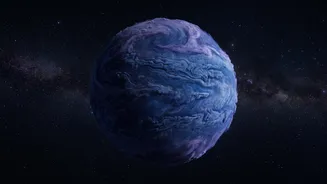
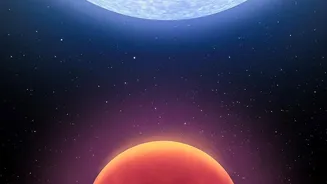
This evidence led astronomers to a radical hypothesis: they are witnessing a 'second-generation' planet. The theory is that after the original star died and became a white dwarf, the material it shed didn't all disperse into space. Instead, some of it may have been captured in orbit, forming a new disk of gas and dust around the stellar remnant. From this debris disk, a new planet—a gas giant likely similar in size to Jupiter—could have formed. As lead author Jamie Williams of the University of Warwick noted, 'It's a bit like finding a planet that has risen from the ashes of the very star it once orbited'. If confirmed, it would be the first such planet discovered around a white dwarf, a much more common type of dead star than the pulsars where similar worlds have been suspected.
An Evaporating World
Further observations support the planet's existence. Data from NASA's TESS spacecraft detected a regular dip in the white dwarf's brightness every 4.4 days. This periodic dimming is consistent with a large object, like a Jupiter-sized planet, orbiting the star very closely. Because the white dwarf is still young and extremely hot, its intense radiation is likely blasting the planet, causing its atmosphere to evaporate into space. This evaporating material then falls onto the white dwarf, which is how its unusual chemical elements become detectable in the first place. Despite this atmospheric stripping, researchers believe the planet is large enough to survive for a very long time.