
An Ever-Growing Family
Just a few years ago, the race for the planet with the most moons was a close contest. But recent advancements in telescope technology have led to an explosion in discoveries. In a series of announcements, Saturn's confirmed moon count has skyrocketed.
In May 2023, the tally jumped to 146, making it the first planet known to have over 100 moons. Then, in a massive update in March 2025, astronomers confirmed 128 new moons at once, bringing the total to 274. By mid-2026, further discoveries pushed the count to the current 293. This rapid increase is thanks to powerful ground-based telescopes that can spot tiny, faint objects orbiting far from the planet, revealing a system far more populated than we ever imagined.
Regular vs. Irregular Moons
The complexity begins with how these moons orbit. Scientists divide them into two main categories: regular and irregular. Regular moons are the well-behaved members of the family. They follow stable, nearly circular orbits close to Saturn's equator and move in the same direction as the planet's rotation (a prograde orbit). This group includes the large, famous moons we have known about for centuries. In contrast, the vast majority of Saturn's moons are irregular. These are the system's wild children. They have large, eccentric, and highly inclined orbits, often travelling backwards (retrograde) against the planet's spin. These chaotic paths suggest they weren't born alongside Saturn but had a much more violent origin story.
A History of Cosmic Violence
So where did all these irregular moons come from? The leading theory is that they are not native to the Saturn system. Instead, they are likely former asteroids or other small bodies that were captured by Saturn's immense gravity long ago. The scattered nature of their orbits also points to a violent past. Many of these moons are thought to be fragments of larger bodies that collided and shattered. Astronomers believe one or more major collisions may have occurred hundreds of millions of years ago, creating families of debris that now orbit the planet as dozens of tiny, individual moons. Studying these remnants gives scientists a fossil record of the chaos that defined the early solar system.
A Diverse Cast of Characters
Beyond the sheer numbers and orbital mechanics, the system's complexity lies in its incredible diversity. You have Titan, a moon larger than the planet Mercury, with its own thick nitrogen atmosphere and lakes of liquid methane. Then there is Enceladus, a small, icy world that shoots jets of water into space from a subsurface ocean, making it a prime target in the search for extraterrestrial life. Other moons are just plain strange. Iapetus is a world of stark contrast, with one hemisphere as bright as snow and the other as dark as tar. Some moons are shaped like potatoes or even ravioli due to accumulating ring material. Two moons, Janus and Epimetheus, are co-orbital, swapping places every four years in a delicate gravitational dance. This variety shows that a 'moon' can be many different things.
Blurring the Line with Rings
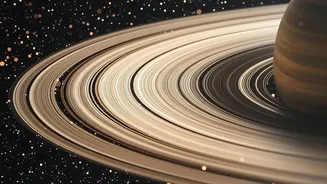
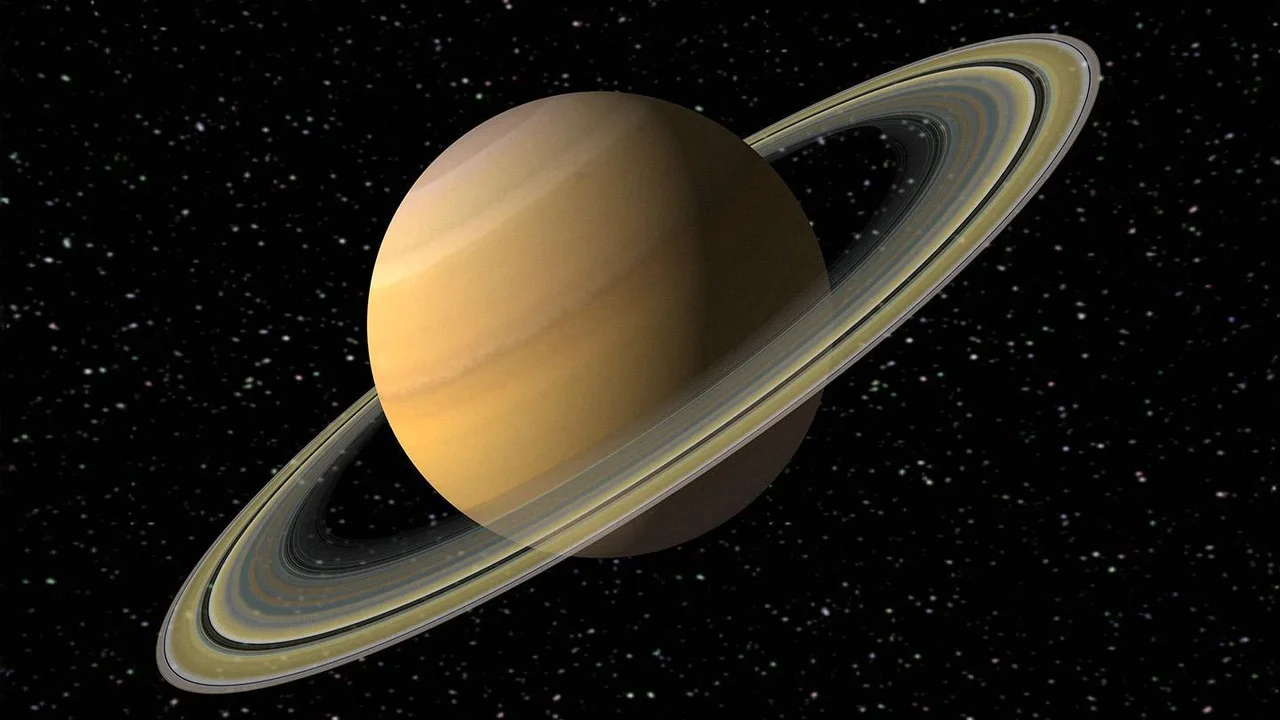
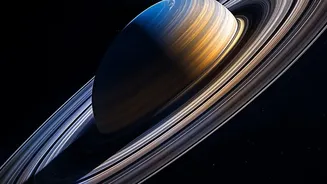
The official count of 293 doesn't even tell the full story. Saturn's famous rings are composed of countless particles of ice and rock, ranging in size from dust grains to boulders. Within these rings, there are hundreds of objects large enough to be considered 'moonlets', some up to half a kilometre across. These are not included in the official tally because the line between a large ring particle and a small moon is blurry. These moonlets, along with shepherd moons that sculpt the edges of the rings, create a dynamic and interconnected system where it is difficult to tell where the rings end and the moons begin. This adds another layer to the intricate architecture of the Saturnian system.