


A Galaxy with a Violent History
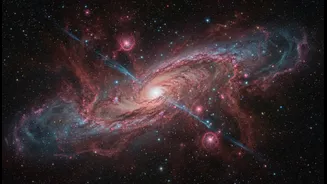
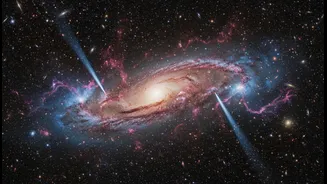
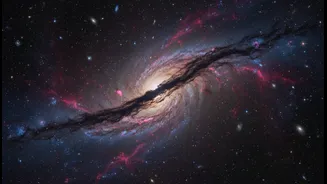
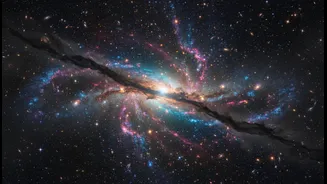
Located about 11 million light-years from Earth, Centaurus A is one of the closest active galaxies to our own. It’s long been a subject of fascination due to its peculiar appearance—a bright, elliptical galaxy sliced in half by a thick, dark lane of dust.
Scientists have long believed this unique structure is the result of a colossal cosmic collision. Roughly two billion years ago, a large elliptical galaxy merged with a smaller spiral galaxy, leaving behind the warped, dusty disc we see today. At its heart lies a supermassive black hole, actively feeding on surrounding gas and dust and spewing out powerful jets of energy that shape the entire galaxy. This combination of a recent merger and an active black hole makes Centaurus A a perfect natural laboratory for understanding how galaxies evolve.
The Power of Seeing in Infrared
Observing the core of Centaurus A has always been a challenge. The very dust that makes the galaxy so visually striking in visible light also acts like a cosmic curtain, blocking our view of what lies within. Previous powerful observatories like the Hubble Space Telescope were stymied by these opaque dust lanes. Early infrared telescopes, like the now-retired Spitzer Space Telescope, could peer through the dust to see large-scale structures but lacked the sharpness to resolve individual stars and fine details. This is where the James Webb Space Telescope (JWST) changes the game. By observing in near- and mid-infrared light, Webb can not only penetrate the thick dust but also do so with unprecedented clarity and depth. The result is that a region once seen as a hazy glow has been transformed into a sparkling tapestry of millions of individual stars.
A Treasure Trove of New Discoveries
The latest images from the JWST, released to mark the telescope's fourth anniversary of science operations, have unveiled a host of new details. The most striking revelation is the sheer number of individual stars now visible within the galaxy's core. What once looked like a fuzzy, glowing mass is now resolved into a dense field of millions of distinct points of light. The images also reveal intricate, glowing filaments and clouds of warm dust that were previously hidden. Astronomers were surprised to find a peculiar S-shaped structure near the galaxy's center, its origin still a mystery that may be linked to the ancient collision or the black hole's activity. The iconic dust lane itself is shown in stunning new detail, appearing not as a solid band but as a complex, parallelogram-shaped structure woven with bright knots and wispy tendrils.
Galactic Archaeology in Action
Being able to see individual stars is more than just a pretty picture; it turns astronomy into a form of galactic archaeology. By studying the different types and ages of the millions of stars revealed by Webb, scientists can reconstruct a timeline of Centaurus A's history. They can identify which stars existed before the merger, which were born in the burst of star formation triggered by the collision, and which formed more recently from the leftover gas and dust. This allows them to piece together the sequence of events that shaped the galaxy with far greater precision than ever before. Every new detail helps astronomers understand the fundamental processes that drive the evolution of all galaxies, including our own Milky Way.
The Black Hole's Complex Influence
The new infrared views also provide critical clues about the relationship between a supermassive black hole and its host galaxy—one of the biggest questions in modern astronomy. Webb's instruments can measure the movement of gas around the black hole, revealing a complex interplay. Early observations show a rotating disk of warm hydrogen gas being pulled toward the black hole, while other gas is being pushed outward at high speeds by energetic jets. This data suggests the black hole has a dual role: it can trigger the birth of new stars by compressing gas clouds, but it can also halt star formation by violently blowing away the necessary raw material. Centaurus A provides a rare, close-up look at this cosmic tug-of-war in action.