





Your AI Co-Pilot, Not the Author
The single most important rule when using AI for job applications is to treat it as a co-pilot, not the pilot. While nearly 90% of companies used AI to screen candidates in 2025, hiring managers are also wary of applications that sound entirely machine-generated.
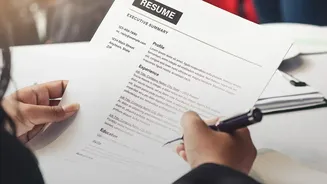
The goal is not to have AI write your resume from scratch, but to use it as a powerful assistant to polish your own story. Think of AI as a tool for overcoming writer's block, identifying missing keywords, and refining your language for clarity and impact. Your experience, your voice, and your accomplishments must remain at the core. The most successful job seekers use AI to augment their efforts, not replace them.
Choosing Your Free AI Toolkit
The market is flooded with AI tools, but for refining resumes and cover letters, you can focus on a few key types. Large Language Models (LLMs) like OpenAI's ChatGPT, Google's Gemini, and Anthropic's Claude offer robust free tiers perfect for drafting, rewriting, and brainstorming. Many also have features specifically designed to help with career tasks, like generating cover letter templates or practicing interview questions. Then there are specialized platforms, many with generous free offerings, that focus specifically on job applications. Tools like Rezi, Kickresume, and others can help check your resume against Applicant Tracking Systems (ATS) and tailor it to specific job descriptions. You don't need to use them all; find one or two that fit your workflow.
The Art of the Perfect Prompt
The quality of your AI output depends entirely on the quality of your input. A vague prompt like "write me a resume summary" will yield a generic, unusable result. A strong prompt provides role, context, and constraints. For a resume summary, try this structure: "Act as a professional resume writer. Write a 4-sentence summary for a [Job Title] with [X] years of experience in the [Industry] industry. Emphasize my skills in [Skill 1] and [Skill 2]. Here is my current resume and the target job description for context: [Paste text here]." This level of detail guides the AI to produce a relevant and personalized draft that you can then refine.
Tailoring for a Global Audience
This is where AI becomes invaluable for international job seekers. Different cultures have different communication norms. A cover letter for a job in the United States might be more enthusiastic and direct than one for a role in Japan, which may value humility and a focus on teamwork. You can use AI to navigate these nuances. Use prompts like: "Rewrite this cover letter for a formal business context in Germany, focusing on technical skills and directness." or "Adapt this summary for a UK audience, ensuring the tone is professional but not overly confident. Remove any American-specific idioms." AI can also help translate your resume, but always have a native speaker review the output if possible.
Refining Your Resume Summary
Your resume summary is your 30-second elevator pitch. It needs to be sharp, concise, and packed with relevant information. Start with your own draft. Then, feed it to an AI along with the job description of your target role. Use a prompt like: "Review my resume summary and the job description below. Identify 3-5 keywords from the job description that are missing from my summary and suggest how to integrate them naturally. Make the summary more results-oriented by highlighting quantifiable achievements." This iterative process of drafting, getting AI feedback, and refining is the key to a powerful summary.
Polishing Your Cover Email
A cover email is often the first direct contact a recruiter has with you. It must be flawless. AI can generate a solid first draft based on your resume and the job description, saving you from the blank page. But its real strength is in refinement. After you've edited the draft to reflect your personality, use AI for a final polish. Try prompts like: "Review this cover email for tone. Is it appropriately formal for a [Industry] company?" or "Make this email more concise, cutting it down by 25% without losing the key message." These tools can catch awkward phrasing or grammatical errors that you might miss after reading the same text multiple times.
The Final Human Review is Non-Negotiable
Never copy and paste directly from an AI tool and hit send. This is the biggest mistake job seekers make. AI models can hallucinate, inventing qualifications or experiences you don't have. They can also produce text that, while grammatically correct, feels lifeless and generic. Always read the AI's output carefully. Rewrite sentences to sound like you. Verify every single fact and number. A free ATS checker can also be a good final step to ensure your formatting is readable by automated systems. Your final application should be a partnership between your experience and AI's refinement capabilities.