

Cosmic Chirps: A Primer on Gravitational Waves
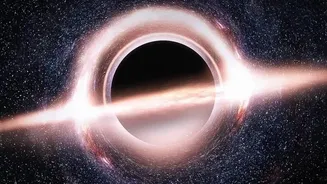
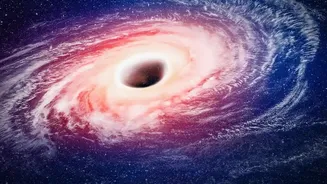
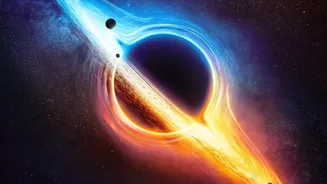
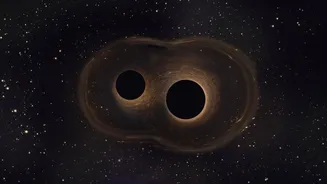
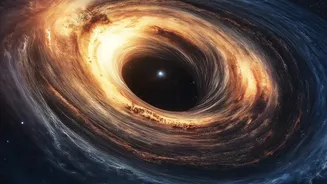
First predicted by Albert Einstein a century ago, gravitational waves are disturbances in the fabric of spacetime itself. They are created by the most cataclysmic events in the cosmos, like the collision of two black holes. As these massive objects spiral
into each other, they send out waves travelling at the speed of light. By the time these waves reach Earth, they are incredibly faint. Observatories like LIGO (Laser Interferometer Gravitational-Wave Observatory) use hyper-sensitive lasers to detect these minuscule distortions. Scientists often describe the signal from a black hole merger as a 'chirp'—a sound that rapidly increases in frequency and amplitude just before the collision. This chirp is a data-rich fingerprint of the event that created it.
A New Cosmic Ruler
One of the biggest questions in cosmology is how fast the universe is expanding. Gravitational waves provide a completely new and independent way to measure this, a method called the 'standard siren' approach. The signal from a merger tells scientists the intrinsic energy of the event. By comparing this to how faint the signal is when it reaches us, they can calculate the distance to the source with remarkable accuracy. When these gravitational wave events also produce a flash of light—as is the case with colliding neutron stars—astronomers can pinpoint the host galaxy and measure how fast it's moving away from us. This allows for a direct calculation of the Hubble constant, the rate of cosmic expansion, helping to resolve a long-standing tension between other measurement methods.
Reading the Black Hole Fossil Record
Each gravitational wave detection is like finding a new fossil, telling us about the 'population' of black holes across cosmic time. The data reveals their masses, spins, and how they are distributed throughout the universe. Scientists are discovering black holes in a mass range they once thought was impossible, challenging existing theories about how stars live and die. Some of the most massive black holes detected seem to be 'second-generation' objects, formed from the merger of smaller black holes that had already merged before. This process, known as hierarchical merging, likely happens in the ultra-dense cores of star clusters and helps explain the formation of the supermassive black holes found at the centre of most galaxies.
Unveiling the Universe's Hidden Structures
By cataloguing hundreds of these merger events, scientists are essentially creating a map of the universe's most massive and violent history. The growing catalogue of detections from the LIGO-Virgo-KAGRA collaboration—which recently surpassed 390 events—is providing a statistical look at how black holes grow and where they form. This isn't just about individual collisions; it's about understanding the entire ecosystem of stellar evolution and galaxy formation. The data allows astrophysicists to test and refine their models of how cosmic structures build up over billions of years, from the first stars to the sprawling galaxies we see today.
India's Role in Listening to the Cosmos
India is set to become a major hub in this scientific frontier with the construction of the LIGO-India observatory in Maharashtra. Expected to begin observations by 2030, LIGO-India will be a crucial addition to the global network of detectors. Adding a fourth major observatory greatly improves the network's ability to pinpoint the exact location of a gravitational wave source on the sky. This enhanced 'triangulation' is vital for multi-messenger astronomy, where scientists race to point conventional telescopes at the source to capture any associated light or radiation. India's involvement not only boosts the global scientific effort but also positions the nation as a leader in one of the most exciting fields of modern physics, inspiring a new generation of scientists.