



The First Glimmer of Discovery
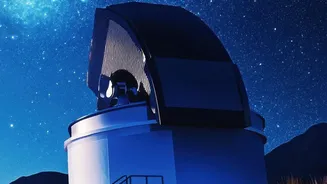
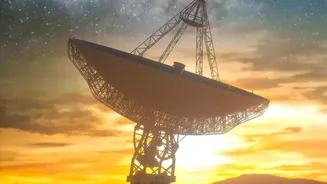
It begins with a faint dot of light moving where it shouldn't be. Observatories like the Catalina Sky Survey or the Mount Lemmon Survey in Arizona constantly scan the night sky, taking sequences of images. Automated software compares these images, searching
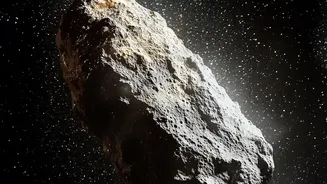
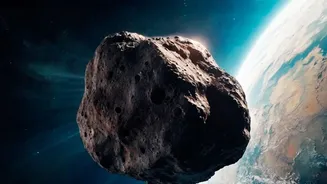
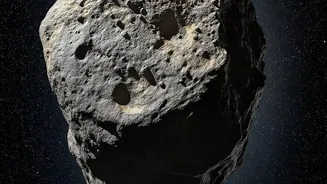
for objects that move against the fixed background of stars. On a night like any other, a new, uncatalogued object is flagged. This was the case on September 6, 2026, when asteroid 2026 RW1 was spotted just over seven hours before it entered the atmosphere. The initial data is sparse but urgent. The discoverer, often an astronomer like the prolific Krisztián Sárneczky who has spotted multiple such objects, immediately sends the coordinates and brightness measurements to the Minor Planet Center (MPC). The MPC is the global clearinghouse for all asteroid and comet observations.
A Global Race Against the Clock
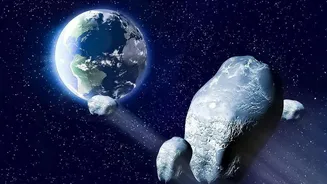
With the initial alert out, a race against time begins. The information is automatically relayed to planetary defense teams at NASA and the European Space Agency (ESA). Systems like NASA's Scout and ESA's Meerkat analyze the preliminary trajectory. Is it a miss, or is it a confirmed impactor? To find out, they need more data. An alert goes out to a worldwide network of observatories, both professional and amateur. As the Earth turns, astronomers in different countries pick up the trail, adding their observations to the MPC. With each new data point, the asteroid's path is refined with astonishing speed. For 2024 BX1, which impacted over Germany in January 2024, over 200 observations were gathered in the three hours between discovery and impact. This global collaboration allows scientists to narrow down the impact time and location from a wide search area to a specific corridor, sometimes just a few tens of kilometres wide.
The Fiery Plunge
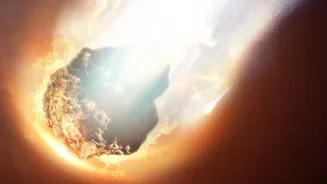
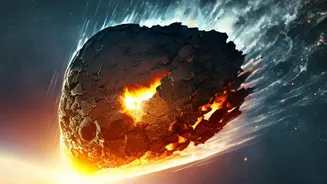
The asteroids detected just hours out are typically small, usually only a few metres across. They pose no significant threat to the ground. Once the trajectory is confirmed to hit Earth, the object is no longer just an asteroid; it's a meteoroid on its final approach. Hitting the upper atmosphere at hypersonic speeds—often over 15 kilometres per second—the meteoroid compresses the air in front of it, creating immense heat and pressure. This isn't burning from friction in the conventional sense, but rather the object incinerating from the superheated air. This causes the rock to glow brilliantly, creating a spectacular fireball, or bolide, that can outshine the full moon. Many of these fireballs are captured by sky-watching networks and even dashcams, as was famously the case with the much larger Chelyabinsk meteor in 2013.
An Explosion of Science
For a car-sized asteroid, the atmosphere is an impenetrable shield. The immense stress causes the meteoroid to break apart violently in an event called an airburst, typically many kilometres up. This explosion can generate a sonic boom heard on the ground, but the pieces themselves rapidly slow down. While the vast majority of the object vaporizes, some tougher fragments can survive the fall. These surviving pieces are now called meteorites. Using data from the fireball's trajectory and local wind patterns, scientists can predict a "strewn field"—an elliptical area where these meteorites are most likely to have landed. This prediction often kicks off a treasure hunt for scientists and private collectors. The fragments of 2024 BX1, for example, were successfully found near Ribbeck, Germany, and identified as a rare type of meteorite called an aubrite, providing invaluable scientific data.