




A New Polygon in the Solar System
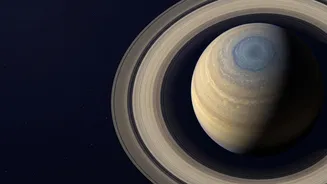
Recent observations from the Hubble Space Telescope have confirmed the presence of a massive, 10-sided atmospheric wave, or decagon, encircling Saturn's south pole. This is the first time a large, regular-sided pattern has been spotted in the planet's
southern hemisphere. For years, the famous six-sided hexagon at the north pole was considered a unique feature, a one-off planetary curiosity. The discovery of a southern counterpart, albeit with ten sides instead of six, suggests that the conditions that create these stunning geometric storms may be more common to Saturn's atmosphere than previously believed.
How Was It Discovered?
The discovery was a collaborative effort between professional and amateur astronomers. Due to Saturn's long seasons and axial tilt, its south pole was largely hidden from Earth's view between 2012 and 2023. As the pole tilted back into view, amateur observers using ground-based telescopes first noticed a strange, wavy feature in 2024. This prompted researchers to use the powerful Hubble Space Telescope to get a closer look. By analyzing Hubble images, including archival data from 2023, scientists confirmed the decagon's existence and found it has been growing more defined over time.
A Tale of Two Poles
While the decagon invites immediate comparison to the northern hexagon, there are key differences. The hexagon has been a stable, observable feature for over 40 years, first spotted by the Voyager probes in the 1980s. The southern decagon, however, appears to be a brand-new phenomenon; it was not seen by NASA's Cassini spacecraft, which orbited Saturn from 2004 to 2017 and closely studied the south pole. The new decagon is also larger than its northern cousin, measuring over 167,000 kilometers wide. This suggests that while both poles can create these shapes, they aren't perfect mirror images of each other.
What Creates These Shapes?
These giant polygons are not solid structures but are believed to be waves within powerful jet streams in Saturn's atmosphere. The northern hexagon is thought to be a standing wave pattern in an eastward-flowing jet. Laboratory experiments have shown that spinning fluids can create similar polygonal shapes, but the exact conditions on Saturn remain a topic of study. The decagon is also embedded in a jet stream, with winds racing at around 420 kilometers per hour. Scientists have determined that the feature is not just a surface-level cloud pattern but a deep, three-dimensional structure that extends through multiple atmospheric layers.
A Rare Opportunity for Science
The most exciting aspect of this discovery is its timing. Unlike the long-established hexagon, the decagon appears to be forming and strengthening right now. This gives scientists a rare, real-time opportunity to study how such a massive planetary weather system develops from its early stages. Researchers are eager to see if the decagon will stabilize into a long-lived feature like the hexagon or if it will evolve and dissipate. One theory suggests a nearby high-pressure vortex, similar to a small version of Jupiter's Great Red Spot, may have helped trigger the wave's formation. Continued observation will be key to understanding the forces at play.