








From Pixels to Pavement
Physical AI is where artificial intelligence meets the messy, unpredictable physical world. Unlike generative AI, which creates text or images in a digital space, physical AI perceives, reasons, and acts in real environments. Think of it as the difference
between a chatbot that can describe how to pick up a box and a robot that can actually see the box, judge its weight, and physically lift it without dropping it. This requires an AI that understands not just data, but physics, motion, and how to react to unexpected events in real-time. It’s a move from the world of bits to the world of atoms, enabling machines to perform complex tasks in warehouses, on construction sites, and even in surgical suites.
Why Robot Dogs Are the Perfect Testbed
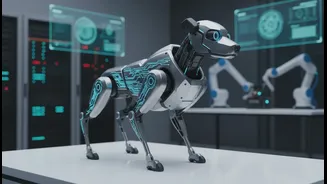
While humanoids and autonomous vehicles are also part of the physical AI revolution, quadruped robots, or 'robot dogs', have emerged as a key platform. Their four-legged design offers a powerful combination of stability and mobility, allowing them to navigate complex, uneven terrain like stairs, rubble, and outdoor environments where wheeled robots would struggle. This makes them ideal for tasks like industrial inspection in power plants, monitoring construction progress, and public safety applications. Companies like Boston Dynamics have already commercialized these platforms, providing a robust, real-world hardware base upon which advanced AI can be layered. They are less complex than a full humanoid but far more versatile than a simple robotic arm, hitting a sweet spot for developing and testing AI that needs to walk, see, and interact with its surroundings.
A New Playbook for AI Teams
For AI developers accustomed to working with clean, digital datasets, physical AI presents a paradigm shift. The primary challenge is no longer just pattern recognition but effective physical action. This requires a new skillset. Expertise in reinforcement learning, where an agent learns by trial and error, is crucial. Since real-world trial and error is slow and risky, creating physically accurate simulations for training is paramount. AI teams must now grapple with the 'sim-to-real' gap, ensuring that behaviours learned in a virtual world translate successfully to hardware. Furthermore, data collection is no longer about scraping the web; it's about capturing real-world sensor data from cameras, LiDAR, and direct physical interaction, which is far more expensive and complex to acquire.
A Mind Meld for Robotics Teams
For robotics engineers, the rise of physical AI means moving beyond pre-programmed, rigid instructions. Historically, industrial robots were designed for repetitive tasks in highly controlled environments. Now, the goal is to build bodies that can host a learning brain. This demands a deeper collaboration between hardware and software specialists. Robotics teams must now design platforms with the sensors and computational power (edge computing) needed to run sophisticated AI models directly on the machine for low-latency decision-making. Interoperability becomes key, as robots from different vendors may need to work together, sharing data and coordinating actions. The focus shifts from simply building a functional machine to creating an adaptive system capable of learning and operating autonomously in dynamic settings.
The Opportunity for India
This global trend has significant implications for India. The country's robotics market is one of the fastest-growing in Asia, with a projected value of over USD 8 billion by 2034. Driven by initiatives like 'Make in India' and a booming electronics and automotive manufacturing sector, the demand for automation is soaring. The integration of AI into robotics is a major opportunity, enhancing efficiency in logistics, healthcare, and agriculture. With a massive pool of STEM graduates and a burgeoning startup ecosystem, India is well-positioned to contribute to and benefit from the physical AI revolution. The challenge and opportunity lie in developing frugal, reliable robotic systems tailored for both domestic needs and emerging markets.