






A Lonely Voyager's Wake-Up Call
For much of its nearly decade-long, three-billion-mile journey to Pluto, the New Horizons spacecraft was asleep. To save power and reduce wear on its systems, the probe entered long periods of electronic hibernation, silently cruising through the void.
During these stretches, it would only send a simple weekly beacon tone back to Earth to report its basic health. But as it neared its historic destination, it was time to wake up for the main event. In December 2014, a pre-programmed command sequence stirred the spacecraft to life, powering up its instruments for the Pluto encounter. The mission team on Earth had to wait, holding their breath for a signal that would travel for hours across billions of miles to confirm the awakening was successful.
The Planet-Sized Telephone Network
Communicating with a spacecraft that far away isn't like making a simple phone call. The signal from New Horizons, traveling at the speed of light, took over four hours and twenty-five minutes to reach Earth. By the time it arrived, the signal was incredibly faint, billions of times weaker than that of a mobile phone. Capturing such a whisper required a truly colossal ear: NASA's Deep Space Network (DSN). The DSN is a global network of massive radio antennas located in California, Spain, and Australia. This strategic placement ensures that as the Earth rotates, one of the stations can always maintain contact with distant spacecraft, from missions orbiting Jupiter to voyagers that have left our solar system entirely.
Giants That Listen to the Cosmos
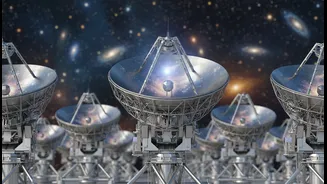
The stars of the Deep Space Network are its giant, 70-meter (230-foot) steerable parabolic antennas—one at each of the three locations. These are the most sensitive instruments in the network, specifically designed to detect the faintest radio signals from the farthest reaches of space. The signal confirming New Horizons' 2014 awakening was received by the 70-meter antenna in Canberra, Australia. These giant dishes use high-frequency radio bands, typically in the X-band (around 7-8 GHz), to communicate. Higher frequencies allow for more data to be packed into the signal and are less affected by Earth's ionosphere, a layer of the atmosphere that can disrupt lower-frequency waves. The antenna's huge surface concentrates the faint incoming radio waves onto a single, ultra-sensitive receiver, amplifying the message from the void.
Decoding a Message from the Void
Receiving the signal is only half the battle. Once the antenna captures the faint radio waves, a complex process of decoding begins. The New Horizons mission control, based at the Johns Hopkins Applied Physics Laboratory, erupted in cheers when they confirmed lock on the spacecraft's carrier signal. This was followed by locking onto the telemetry data, a stream of information confirming the probe's systems were healthy and operating as expected. To ensure data integrity over such vast distances, the information is sent with error-correcting codes, which allow engineers to reconstruct the original message even if parts of it are corrupted during its long journey. It was a 15-minute series of status messages that confirmed the subsequent flyby of Pluto was a complete success, a testament to the robust engineering of both the spacecraft and the ground systems.
Why This Interstellar Handshake Matters
The successful reception of New Horizons' signals wasn't just a technical achievement; it was the vital link that made the entire mission possible. Without the Deep Space Network, the breathtaking images of Pluto's heart-shaped plains and the groundbreaking scientific data from the Kuiper Belt would have remained locked on the spacecraft's recorders, billions of miles away. This ability to communicate across the solar system is the backbone of modern space exploration. It allows us to control robotic explorers in real-time (accounting for light-speed delay), receive their precious findings, and continue to push the boundaries of our knowledge about the universe. Each successful handshake, like that first awakening signal, reaffirms humanity's reach into the cosmos.