
A New Window on Stellar Nurseries
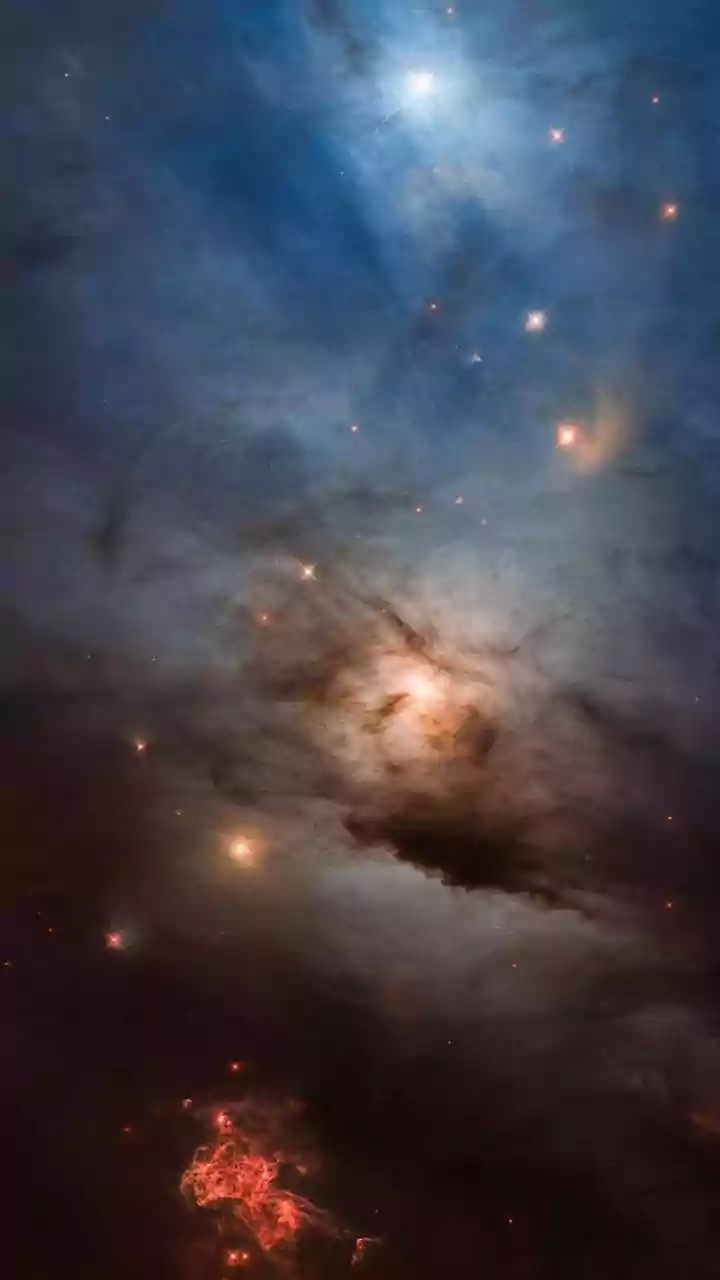
The birth of a star is not a serene event. It happens deep inside vast, dense clouds of gas and dust known as stellar nurseries. To older telescopes operating in visible light, these regions are largely opaque, hiding the action within. The James Webb
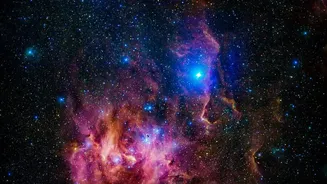
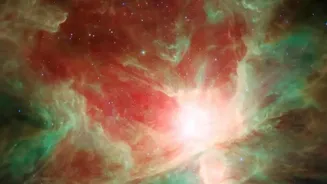
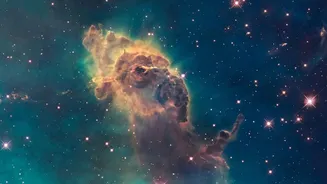
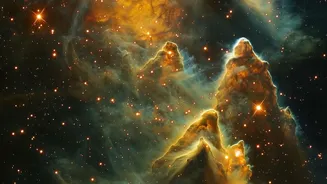
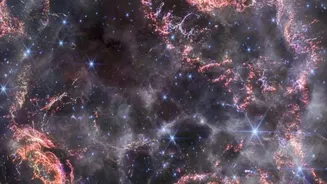
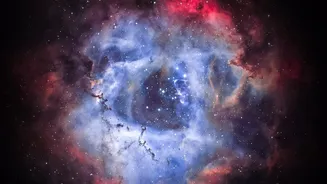
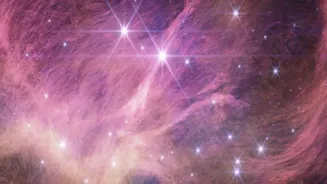
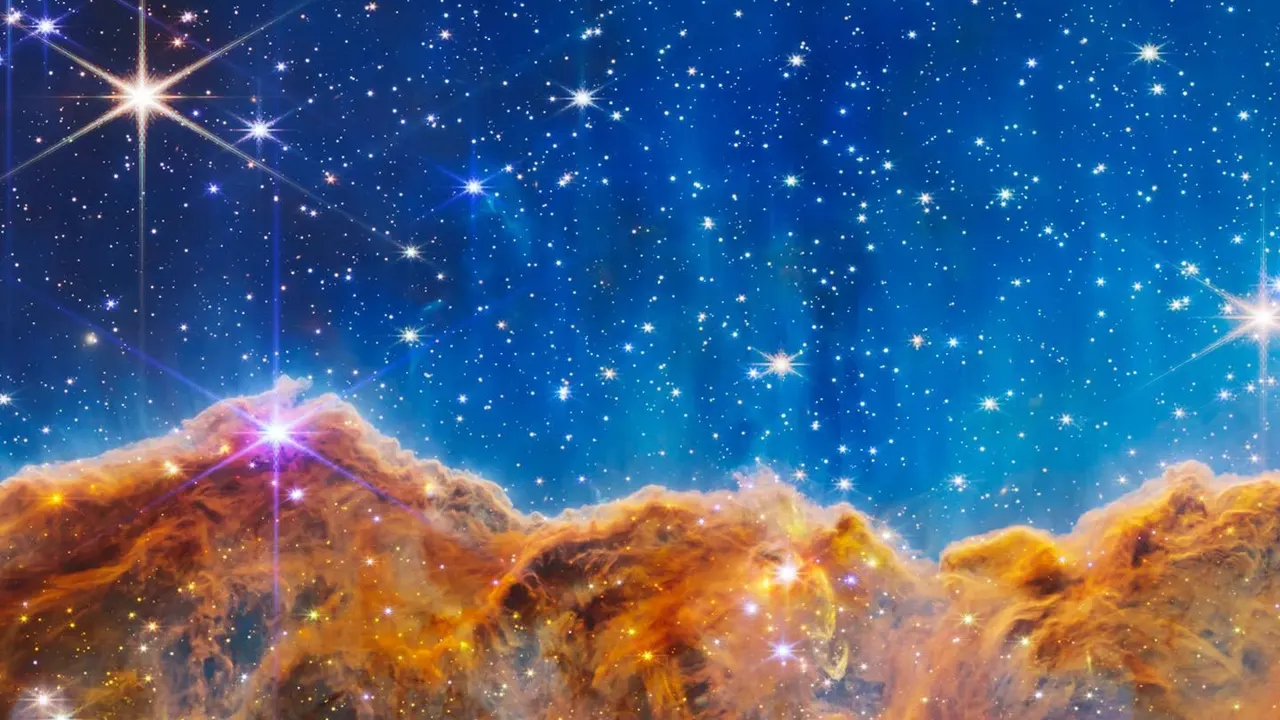
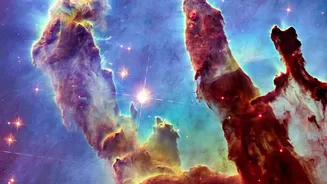
Space Telescope, however, is a game-changer because it sees the universe in infrared light. This allows it to pierce through the shrouds of dust like an intergalactic X-ray, revealing the processes hidden from view. Iconic images like the 'Cosmic Cliffs' in the Carina Nebula showcase this power, transforming what once looked like dark patches of sky into vibrant landscapes of stellar birth. Webb is providing the first clear views of thousands of previously unseen young stars, offering a front-row seat to the formation of new solar systems.
Anatomy of a Newborn Star
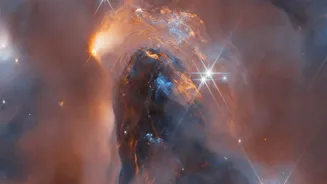
Thanks to Webb, we're seeing the anatomy of a newborn star in stunning detail. At the center of the action is a protostar, a dense, hot core of collapsing gas that hasn't yet ignited into a full-fledged star. Surrounding it is a rotating platter of gas and dust called a protoplanetary disk—the raw material from which future planets will form. As the protostar gobbles up this material, it doesn't just grow; it also ejects powerful jets of gas from its poles at incredible speeds. Observations of regions like Herbig-Haro 211 have shown these jets in unprecedented resolution, revealing shockwaves that carve through the surrounding cloud. Astronomers can even see these jets 'wiggle', providing a historical record of the star's sporadic feeding frenzies over thousands of years.
A Cosmic Race Against Time
One of the most profound insights from Webb is that planet formation is a frantic race against the clock. By studying dozens of young, Sun-like stars, astronomers have learned that the protoplanetary disks don't last forever. The same young star that provides the building materials for planets is also actively trying to blow them away. Early in a star's life, powerful winds driven by magnetic fields push gas and dust out of the system. Later, as the star's own light becomes more intense, its radiation heats and evaporates the remaining gas in a process called photoevaporation. This means gas giants like Jupiter must form their massive atmospheres quickly, before all the necessary gas is cleared away. The window of opportunity for planet formation can be surprisingly short.
Rewriting the Astronomical Rulebook
JWST isn't just confirming old theories with prettier pictures; it's forcing scientists to rewrite the rulebook on star formation. In the NGC1333 cluster, Webb found Jupiter-sized objects forming in isolation, blurring the line between the smallest stars and the largest planets. In Sagittarius B2, the most active star-forming region in our galaxy, it uncovered countless stars that were completely invisible before, suggesting these stellar nurseries are even more productive than we thought. Furthermore, Webb detected unexpected ultraviolet radiation around protostars in the Ophiuchus cloud, a phenomenon current models can't fully explain. These discoveries show that the universe is more complex and surprising than our theories predicted, pushing astronomers to refine their understanding of how galaxies and stars evolve.