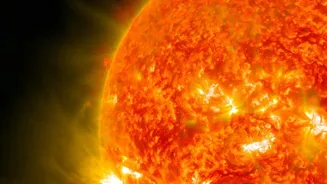







India's Unblinking Solar Observatory
Launched by the Indian Space Research Organisation (ISRO), Aditya-L1 is the nation's first dedicated space-based mission to study the Sun. It is strategically positioned at Lagrange Point 1 (L1), about 1.5 million kilometres from Earth, a unique spot
where the gravitational forces of the Sun and Earth balance out. This vantage point allows the spacecraft's seven sophisticated instruments to maintain a continuous, uninterrupted watch on our star, free from the eclipses and atmospheric distortions that hinder ground-based observations. Its primary goal is to observe the Sun's outer layers—the photosphere, chromosphere, and the enigmatic corona—to better understand the dynamics that drive space weather.
The Mystery of the Sun’s Fiery Crown
One of the most perplexing questions in astrophysics is the coronal heating problem. The Sun's visible surface, the photosphere, has a temperature of about 5,500 degrees Celsius. Yet, its outer atmosphere, the corona, sizzles at a staggering two million degrees Celsius, and can even spike to 40 million degrees during active periods. This defies simple logic; it's like a fire being cooler than the air several feet away from it. The corona is also the birthplace of solar flares and massive eruptions of plasma called Coronal Mass Ejections (CMEs). Understanding how the corona gets—and stays—so incredibly hot, even while constantly losing energy through these eruptions, is key to understanding the Sun itself.
Why Solar Storms Matter on Earth
When the Sun ejects a CME towards Earth, it's often called a solar storm. While these storms can produce beautiful auroras, they also pose a significant threat to our modern, technology-dependent civilisation. A powerful solar storm can compress Earth's protective magnetic shield, exposing satellites to harsh radiation. It can disrupt GPS and navigation services, interfere with radio communications essential for aviation and shipping, and induce powerful electrical currents in power grids that can damage transformers and cause widespread blackouts. As our reliance on digital infrastructure grows, so does our vulnerability to these celestial events.
What the New Data Reveals
Recent findings from Aditya-L1, published in the Astrophysical Journal Letters, provide compelling new evidence in the quest to understand the corona. A study led by Professor R. Ramesh of the Indian Institute of Astrophysics (IIA) used data from the Visible Emission Line Coronagraph (VELC) payload to analyze an energetic CME. Scientists have long debated two main theories for coronal heating: energy carried by waves from the Sun's bubbling surface, and energy released when tangled magnetic field lines snap and reconnect. The Aditya-L1 data allowed researchers to quantify these contributions for the first time. The results were striking: waves from the surface accounted for only about 7% of the energy needed to heat the corona, while a staggering 93% came from the constant reconfiguration of magnetic fields.
A Leap Towards Better Predictions
This discovery does more than just chip away at a long-standing scientific mystery; it has profound practical implications. The same magnetic reconnection that appears to superheat the corona is also the engine driving solar flares and CMEs. By providing clear, continuous data on these magnetic processes, Aditya-L1 helps scientists build more accurate models of the Sun's behaviour. This moves the needle on space weather forecasting from simply observing an eruption to potentially predicting when and how one might occur. Improved forecasting gives authorities and operators of critical infrastructure more warning time to take protective measures, safeguarding everything from our power grids to the satellites that connect our world.