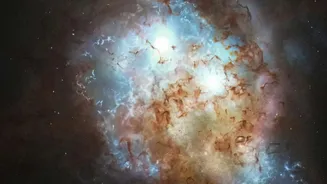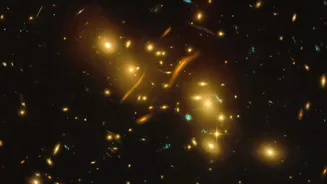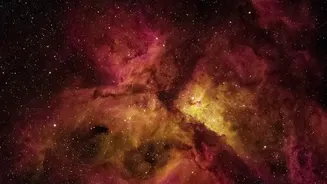

Why spend billions to launch a telescope into space when we can build bigger ones on the ground? It’s a fundamental question in astronomy, and the answer reveals a fascinating story of trade-offs between seeing clearly and seeing everything.
The Atmosphere: A Blurry, Flickering Obstacle
The single
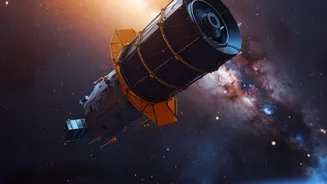
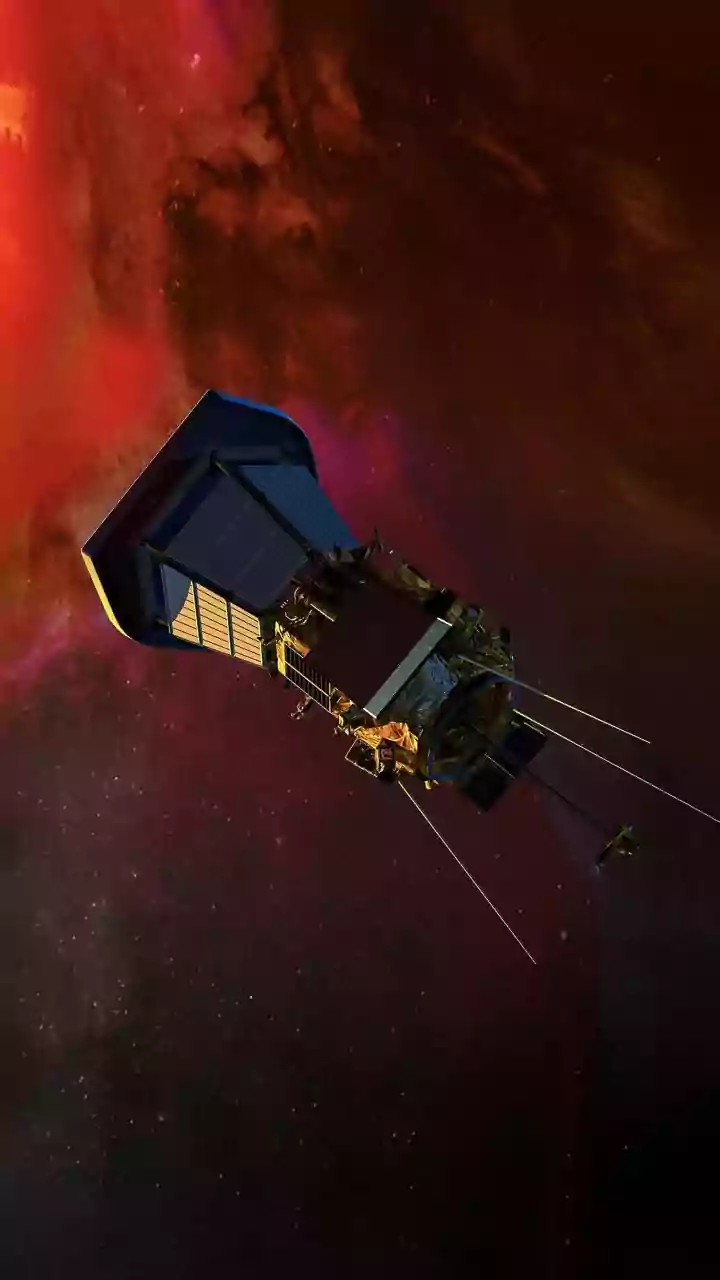
biggest advantage of a space telescope is that it orbits above Earth's atmosphere. For ground-based telescopes, the atmosphere is a constant source of frustration. The same turbulence and temperature variations that cause stars to 'twinkle' to the naked eye wreak havoc on astronomical images. This atmospheric 'seeing' blurs fine details, limiting how sharp an image a ground-based telescope can achieve, regardless of how large or powerful its mirror is. By placing a telescope in the vacuum of space, like the Hubble or James Webb Space Telescopes, astronomers get a perfectly stable, crisp view of the cosmos, free from this distortion.
Seeing the Invisible Universe
Our atmosphere does more than just blur images; it acts as a protective blanket, blocking most of the electromagnetic spectrum. While visible light and some radio waves make it to the surface, other crucial forms of light—like X-rays, gamma rays, ultraviolet, and much of the infrared spectrum—are absorbed. Many of the universe's most dramatic events and objects, from black holes to the birth of stars, radiate intensely in these 'invisible' wavelengths. To see them, we have no choice but to go to space. Telescopes like the Chandra X-ray Observatory and the infrared-sensitive James Webb Space Telescope are designed specifically to capture this light that never reaches the ground.
The Ground Strikes Back with Adaptive Optics
Astronomers haven't simply surrendered to the atmosphere's whims. Ground-based observatories now use a remarkable technology called adaptive optics. This system uses a powerful laser to create an 'artificial star' in the upper atmosphere. A sensor measures how the atmosphere distorts this artificial star's light thousands of times per second. This information is fed to a computer that then minutely deforms a smaller, flexible mirror in the telescope's light path, cancelling out the atmospheric blurring in real-time. This innovation allows modern ground telescopes to produce images that are incredibly sharp, sometimes rivalling the clarity of space-based observatories in visible light.
The Practical Limits: Cost, Size, and Repairs
This is where ground-based telescopes have a clear and significant edge. Building, launching, and operating a space telescope is astronomically expensive. The James Webb Space Telescope, for example, cost around $10 billion, whereas next-generation giant ground telescopes cost a fraction of that, in the range of $1-2 billion. On the ground, you can build much, much larger telescopes, and a bigger mirror means you can collect more light to see fainter, more distant objects. Furthermore, ground telescopes can be regularly maintained, repaired, and upgraded with new technology. Most space telescopes, especially those in distant orbits, are impossible to service if something goes wrong.
A Powerful Partnership
Ultimately, space and ground telescopes are not rivals but partners in a complementary quest. They serve different but equally vital purposes. A space telescope might make a groundbreaking discovery in infrared or ultraviolet light, and giant ground-based telescopes can then perform detailed follow-up observations, using their massive mirrors to gather more light and analyze the object's chemical composition or motion. Space telescopes give us an unobstructed, multi-wavelength view, while ground telescopes provide the sheer light-collecting power and flexibility needed for deep-sky surveys and long-term studies. Together, they give us a more complete and comprehensive picture of the universe than either could alone.