




A Universe of Watery Worlds
For decades, finding water beyond Earth was the stuff of science fiction. Now, thanks to powerful instruments like the James Webb Space Telescope (JWST), it's becoming a regular occurrence. Scientists have detected the chemical signature of water vapour
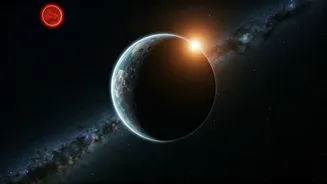
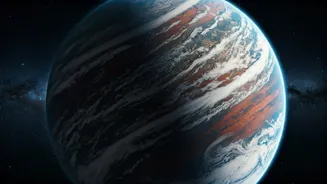
in the atmospheres of numerous exoplanets—planets orbiting stars other than our Sun. One recent example is GJ 9827d, the smallest exoplanet to date where water has been found. It's a world about twice the diameter of Earth, located 97 light-years away. These discoveries are not just about finding H2O; they are about understanding the diversity of planets in our galaxy. Many of these worlds, like the gas giant WASP-96 b or the 'sub-Neptune' TOI-421 b, are nothing like Earth. Yet, the presence of water confirms they have atmospheres, a critical first step in assessing their nature.
How to See Water From Light-Years Away
Detecting atmospheric components from trillions of kilometres away is a remarkable feat of science. Astronomers use a technique called transit spectroscopy. When an exoplanet passes in front of its host star from our point of view, a tiny fraction of the starlight is filtered through the planet's atmosphere. Different molecules absorb light at specific wavelengths, leaving a unique chemical fingerprint on the light that reaches our telescopes. The James Webb Space Telescope, with its incredible sensitivity to infrared light, is particularly adept at this. It can identify not just water, but other key molecules like methane, carbon dioxide, and even sulfur dioxide, painting a more complete picture of a planet's atmospheric chemistry. This method has allowed scientists to peer into the skies of planets that were previously just smudges of data, revolutionising the field of exoplanet characterisation.
The 'Hycean' World Hypothesis
The discovery of water has led to an intriguing new category of planet: the 'Hycean' world. First theorized in 2021, this term describes a hypothetical planet with a liquid water ocean under a hydrogen-rich atmosphere. These worlds, like the much-studied K2-18 b, are often larger than Earth but smaller than Neptune and could have conditions suitable for life. The exciting part is that their larger size and puffy atmospheres make them easier to observe than smaller, Earth-like rocky planets. This could accelerate the search for biosignatures—the chemical traces of life. However, the Hycean concept is still debated. Some scientists argue that many of these planets would be too hot, creating a runaway greenhouse effect or a state where water becomes a 'supercritical fluid'—a strange state between liquid and gas—at scorching temperatures of up to 4,000°C.
Why Water Doesn't Equal Habitable
Finding water vapour is a monumental discovery, but it’s just one ingredient in a complex recipe for habitability. A planet needs to be in the 'habitable zone'—the orbital range where temperatures allow liquid water to exist on a surface. But even that isn't enough. Many planets with water are inhospitable. GJ 9827d, for example, is as hot as Venus, with surface temperatures around 430°C, meaning any water would exist as scorching steam. Other factors are crucial: the planet's mass, the strength of its magnetic field, the composition of its atmosphere, and the stability of its host star all play a role. Many water-bearing planets orbit red dwarf stars, which are prone to violent flares that could strip away atmospheres and irradiate any potential life.
The Journey to Finding Earth 2.0
Every detection of water vapour, even on a world that is clearly not a 'second Earth,' is a vital data point. It helps scientists refine their models of how planets form and evolve. The discovery of water on GJ 9827d, a planet that might have formed farther from its star and migrated inward, helps test theories of planetary formation. The ultimate goal is to find a truly Earth-like world: a rocky planet, in a stable orbit around a Sun-like star, with liquid water on its surface and an atmosphere containing a mix of gases that point towards life. We are not there yet. The technological challenges of finding and characterising such a small, distant world are immense. But each new world with water in its sky brings us a little closer, teaching us where to look next and what to look for in the ongoing search for life beyond our solar system.