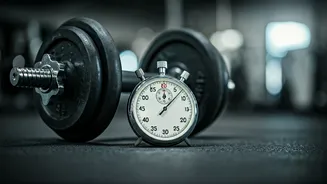









The Legacy of the Long Workout
The belief that you need to spend 90 minutes or more in the gym often comes from traditional bodybuilding culture. This approach typically involves high-volume routines that isolate specific muscle groups on different days. For someone training only once
or twice a week, a longer session of 60 to 90 minutes might seem necessary to target all major muscle groups. This method can be effective, especially for advanced lifters aiming for maximum hypertrophy. However, for the average person juggling work, family, and other commitments, finding that much time can be a significant barrier to consistency. The 'more is better' mindset can lead people to perform excessive sets and exercises, sometimes leading to diminishing returns or burnout.
The Case for Shorter, Smarter Sessions
Modern exercise science increasingly suggests that workout effectiveness isn't measured by the clock, but by the quality of the work performed. For general strength and muscle building, focused sessions lasting 45 to 60 minutes are often sufficient. In fact, for many people, especially beginners, workouts as short as 20 to 30 minutes can deliver significant results if the intensity is high enough. The key is focusing on principles like progressive overload—gradually increasing the weight, reps, or sets—and training volume. Recent research has even shown that performing just one or two very hard, focused sets on a specific exercise can lead to meaningful strength gains, challenging the idea that endless sets are required for progress. This means a well-structured, intense 45-minute workout can often outperform a longer, unfocused session filled with long rests and distraction.
The Hormonal Side of the Story
One of the most compelling arguments against excessively long workouts involves our hormones. Intense exercise is a form of stress, and your body responds by releasing cortisol. While short-term cortisol spikes during a workout are normal and help mobilize energy, prolonged sessions can keep cortisol levels elevated. Chronically high cortisol can interfere with recovery, disrupt sleep, and may even lead to muscle breakdown—the opposite of what most people want from strength training. Research suggests that after about 45 to 60 minutes of intense exercise, the ratio of anabolic (muscle-building) hormones to catabolic (muscle-breakdown) hormones like cortisol can become less favorable. By keeping workouts concise and intense, you can get the muscle-building stimulus without pushing your body into a state of excessive stress that hinders recovery.
Finding Your Personal Sweet Spot
Ultimately, the ideal workout duration is highly individual and depends on your goals, fitness level, and training frequency. If you train four or five days a week, shorter sessions of 20 to 60 minutes for each muscle group are very effective. If you can only make it to the gym once or twice a week, a longer 60-to-90-minute session might be needed to achieve adequate training volume. The structure of your workout also plays a major role. A session focused on heavy compound lifts like squats and deadlifts will require longer rest periods (2-3 minutes) and may naturally extend the workout time. Conversely, using techniques like supersets can help you get more work done in less time. The goal is to stimulate muscle protein synthesis (MPS), the process of repairing and building muscle, which remains elevated for 24 to 48 hours after a good workout. You don't need to annihilate your muscles for two hours to trigger this response.