
Beyond Bullet Points
The traditional process of creating a presentation has long been a frustrating exercise in balancing content with design. For students tackling dense subjects like quantum physics, economic theories, or historical movements, software like PowerPoint often
became a barrier, not a bridge, to clear communication. The challenge wasn't just about what to say, but how to show it. Creating compelling visuals, diagrams, and infographics from scratch required design skills that many students simply don't have, leading to presentations that were visually inconsistent and failed to engage the audience. The focus remained stubbornly on bullet points, which are notoriously poor at conveying nuanced or interconnected ideas. As a result, many brilliant concepts were lost in a sea of poorly formatted text and generic clip art, leaving both the presenter and the audience feeling uninspired.
The Rise of AI Design Assistants
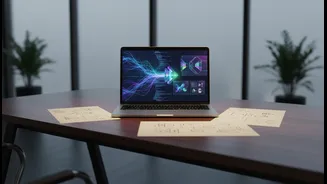
Enter the new class of AI presentation makers. Tools like Gamma, Tome, and Canva's Magic Design are fundamentally altering the creation process. Instead of starting with a blank slide, a student can now input a topic, a document, or a simple outline, and the AI generates a structured, professionally designed first draft in minutes. These platforms act as intelligent assistants, automating the most time-consuming parts of presentation design. They suggest layouts, choose complementary color palettes, source relevant images, and even create custom graphics or charts to illustrate key points. This allows students to bypass the technical hurdles and move straight to refining their narrative and ensuring their core message is powerful and clear. It's a shift from manual formatting to automated storytelling, saving significant time that can be better spent on understanding the subject matter itself.
Visualising the Abstract
The true power of these AI tools lies in their ability to help students explain genuinely complex ideas. Imagine a biology student trying to explain cellular respiration. Instead of a slide packed with text, an AI tool can generate a clean, step-by-step diagram illustrating the Krebs cycle. An economics student can transform raw data into an intuitive infographic showing supply and demand curves. These AI-generated visuals provide a common language that makes abstract concepts tangible and easier for an audience to grasp. By turning dense information into structured, aesthetic visuals, the cognitive load on the audience is reduced. This allows them to focus on the idea being presented, rather than struggling to decipher a cluttered slide. The AI doesn't just make presentations prettier; it makes them more effective teaching instruments.
Democratising Good Communication
One of the most significant impacts of these tools is the democratisation of design. Historically, students with a natural eye for aesthetics or access to premium design software had an unfair advantage. Their presentations simply looked more credible and professional. AI levels the playing field. Now, any student, regardless of their artistic ability, can produce a polished and visually coherent presentation. This ensures that their ideas are judged on their own merit, not on the quality of their slide design. It fosters a more inclusive learning environment where clarity of thought is the primary currency. Students can focus on research and critical thinking, confident that the final presentation will effectively support, rather than detract from, their hard work.
A Note of Caution
Despite the clear benefits, educators and experts urge a thoughtful approach. An over-reliance on AI can lead to a homogenisation of presentations, where everything starts to look the same. More importantly, there are risks of inaccuracy and bias, as AI models can generate plausible-sounding but incorrect information. Students must be taught to use these tools as a starting point, not a final product. The process of fact-checking, critically evaluating AI-generated content, and injecting personal perspective remains essential. Educators are also navigating the ethical lines of when AI use is a helpful aid versus a form of academic misconduct. The consensus is that guidance from teachers is crucial to ensure students use AI to deepen their understanding, not to bypass learning altogether.