





Titan: An Earth-Like World, but Colder
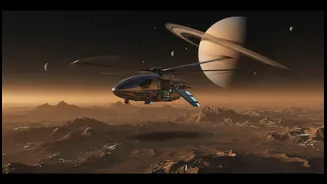
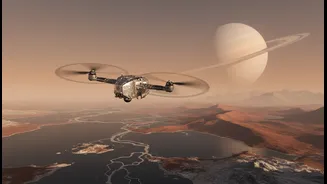
Imagine an alien world with a thick atmosphere, clouds, rain, rivers, lakes, and seas. That’s Titan. But instead of water, its rivers and lakes are filled with liquid methane and ethane, and its surface temperature plunges to an average of minus 179 degrees
Celsius. Its atmosphere, rich in nitrogen and methane, is about four times denser than Earth's. This unique environment, while hostile, presents an incredible scientific opportunity. It's a natural laboratory for studying the kind of complex, carbon-rich chemistry that may have preceded life on our own planet. But exploring it requires a completely new approach.
Why Fly When You Can Roll?
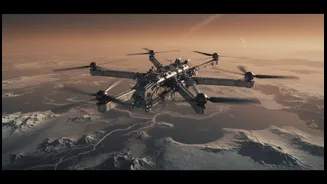
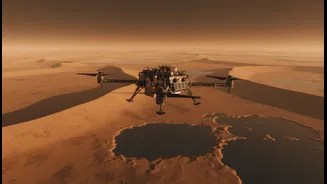
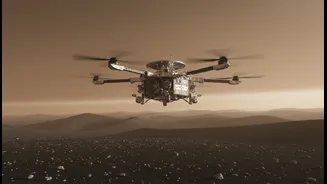
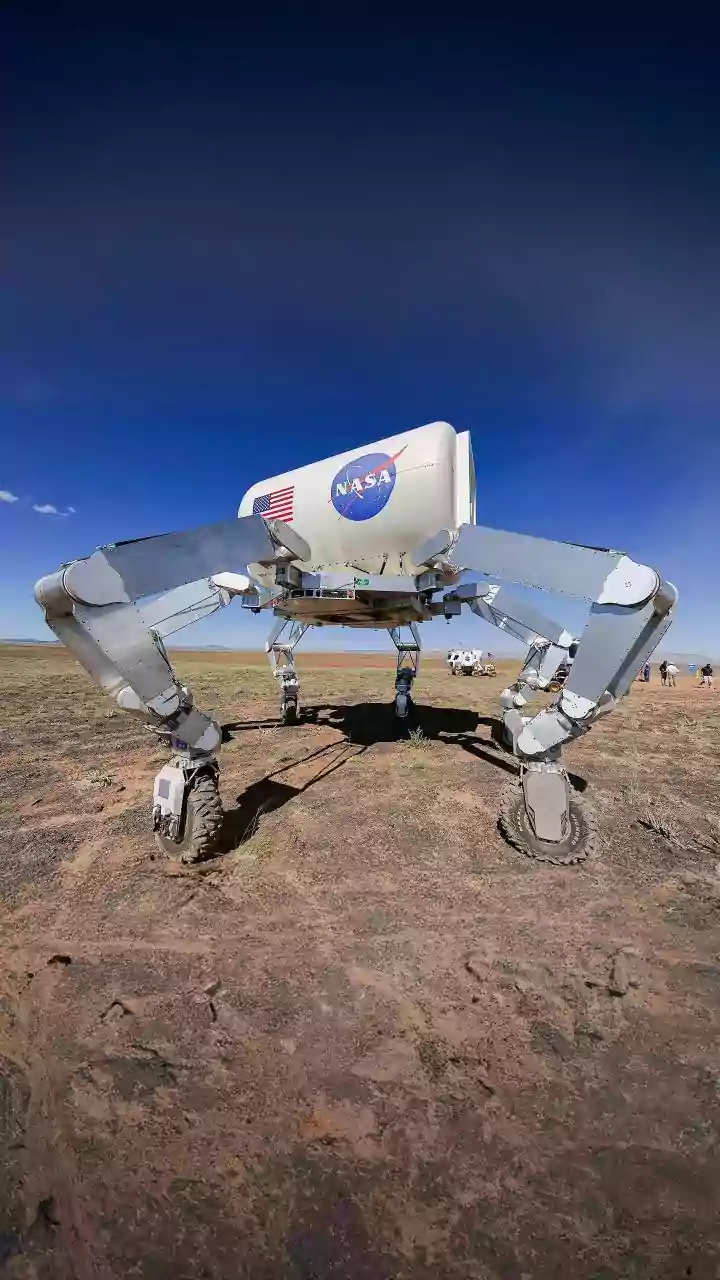
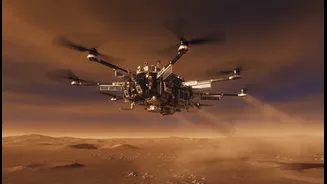
For decades, NASA has relied on wheeled rovers to explore Mars. But Titan's diverse and potentially rugged terrain—from vast dunes of organic sand to sites of possible cryovolcanic flows—makes ground travel difficult. A rover would be slow and limited in its reach. Flying solves this problem. Taking advantage of Titan's thick atmosphere and low gravity (about one-seventh of Earth's), the Dragonfly octocopter can easily take off, cover several kilometres in a single flight, and land at scientifically interesting sites that would be unreachable by a rover. This mobility allows Dragonfly to act as a relocatable lander, sampling dozens of diverse locations across hundreds of kilometres during its multi-year mission.
Powering Through a Long, Cold Night
A major hurdle for any mission so far from the sun is power. Solar energy is impractical on Titan, where sunlight is about 1,000 times weaker than on Earth and is further obscured by a thick, hazy atmosphere. To overcome this, Dragonfly will be equipped with a Multi-Mission Radioisotope Thermoelectric Generator (MMRTG). This nuclear power source, also used on the Mars Curiosity and Perseverance rovers, converts heat from the natural decay of plutonium into electricity. It provides a constant, reliable source of power and warmth, regardless of sunlight. During Titan's long nights (each lasting about eight Earth days), the MMRTG will recharge the craft's batteries, preparing it for its next flight.
The Challenge of Autonomous Flight
The travel time for a signal from Earth to reach Titan can be over an hour, making real-time remote control impossible. This means Dragonfly must be highly autonomous. It will need to fly, navigate, and select safe landing spots all on its own. To do this, it will be equipped with a sophisticated suite of sensors, including cameras, lidar, and inertial measurement units. The mission team will select a destination, but the rotorcraft will handle the details of the flight path and touchdown. Fortunately, Titan’s atmosphere is relatively calm, which simplifies flight planning. After landing, the craft will spend most of its time on the ground—about 16 Earth days per cycle—conducting experiments and recharging before its next hop.
A Blueprint for Future Exploration
The Dragonfly mission, scheduled to launch in July 2028 and arrive at Titan in 2034, is more than just a single expedition. It represents a fundamental shift in mission design, proving the viability of powered aerial exploration on other worlds. The technologies developed for Dragonfly—from its cold-resistant electronics and autonomous navigation to its nuclear power system—will inform future missions to other icy moons like Europa and Enceladus, or any world with a substantial atmosphere. By moving beyond stationary landers and limited-range rovers, NASA is creating a template for a new generation of mobile explorers capable of tackling the extreme conditions found in the outer solar system.