






The Desk Worker's Dilemma
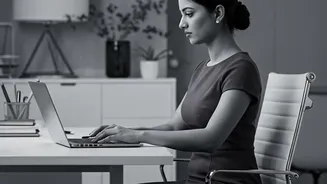
If you spend your day at a desk, you know the feeling: a creeping stiffness that starts in your neck and spreads to your shoulders. This discomfort is a direct result of prolonged sitting and poor posture. When you lean forward to look at a screen, your head,
which weighs around 5 kilograms, puts immense strain on the muscles in your neck and upper back. Over time, this 'forward head posture' causes muscles to become fatigued, tight, and sore. The body is designed for movement, but desk work forces it into a static position, restricting blood flow and causing waste products like lactic acid to build up in muscle tissue, leading to that feeling of stiffness and pain.
The Foundation: Posture and Breath
Before you even begin to stretch, check your posture. Sit tall in your chair with your feet flat on the floor and your spine supported. Relax your shoulders, letting them drop away from your ears. This position, sometimes called a Seated Mountain Pose, helps align your body and engages your core. Throughout these exercises, focus on your breath. Deep, mindful breathing not only helps you relax but also enhances the effectiveness of each stretch by improving circulation and releasing tension. A simple inhale as you prepare for a movement and an exhale as you deepen the stretch can transform a simple exercise into a powerful moment of relief.
Movement 1: Seated Cat-Cow
This classic yoga movement is excellent for waking up a stiff spine. Sit at the edge of your chair with your hands on your knees. As you inhale, gently arch your back, push your chest forward, and look up toward the ceiling without dropping your head back completely (Cow Pose). As you exhale, round your spine, tuck your chin toward your chest, and feel a stretch in your upper back (Cat Pose). The movement should be slow and controlled, flowing with your breath. Repeat this cycle 5 to 10 times to gently mobilize the spine and relieve tension from your neck to your lower back.
Movement 2: Seated Spinal Twist
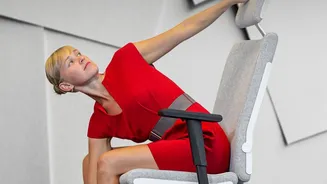
A gentle twist can work wonders for shoulder, neck, and back tightness. Sit tall with your feet flat on the floor. To twist to your right, place your left hand on your right knee and your right hand on the armrest or back of the chair for support. Inhale to lengthen your spine, and as you exhale, gently rotate your torso to the right. Keep your head in line with your spine and use your breath to guide you deeper into the twist, rather than forcing it. Hold for a few deep breaths, then slowly return to the center and repeat on the other side. This movement improves spinal mobility and massages the muscles along your back.
Movement 3: Chair Eagle Arms
This pose provides an intense and satisfying stretch for the upper back and the muscles between your shoulder blades, which often become tight from typing and hunching. Extend both arms straight out in front of you at shoulder height. Cross your right arm over your left at the elbows. Bend your elbows and try to bring your palms to touch. If they don't reach, simply press the backs of your hands together. Gently lift your elbows while keeping your shoulders relaxed and down. Hold for 3 to 5 slow breaths, feeling the stretch across your upper back, then release and switch arms.
Movement 4: Neck and Shoulder Rolls
For immediate relief from neck strain, a few simple rolls can make a huge difference. Sit up straight and gently tilt your head toward your right shoulder, holding for 15-20 seconds. You should feel a gentle stretch along the left side of your neck. Slowly roll your chin down toward your chest, and then over to your left shoulder, holding again. Avoid rolling your head all the way back, as this can compress the spine. After stretching your neck, gently roll your shoulders up toward your ears, then back and down in a slow, circular motion for about 15 seconds, then reverse the direction. This releases tension held in the trapezius muscles.