
A Visitor From Another Star
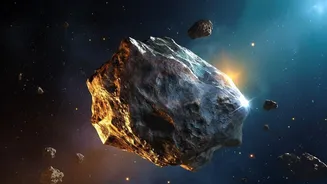
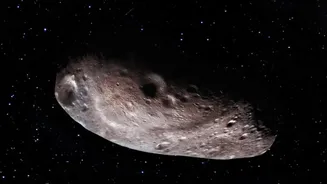
An interstellar object is exactly what it sounds like: a comet or asteroid that originated outside our solar system, from the space between stars. While billions of comets orbit our own Sun, mostly in the distant Oort Cloud, they are gravitationally bound
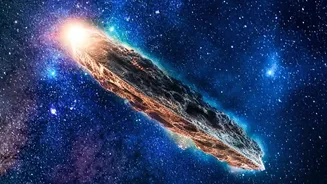
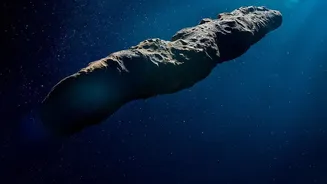
to it, following vast elliptical paths. Interstellar visitors are different. They are not tied to our Sun and are just passing through. We can identify them because they travel at incredible speeds and follow a specific path known as a hyperbolic trajectory, which proves they have enough velocity to escape the Sun's gravity and will never return. The first such object, named 'Oumuamua, was spotted in 2017, followed by the comet 2I/Borisov in 2019. Comet 3I/ATLAS, discovered on July 1, 2025, is the third confirmed member of this exclusive club.
How 3I/ATLAS Was Found
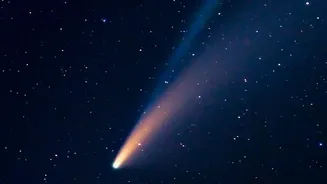
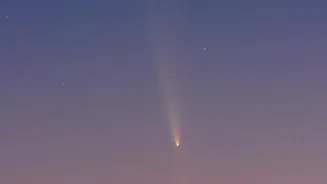
The comet gets its name from its discoverers and its status. The '3I' signifies that it is the third interstellar object detected. The 'ATLAS' comes from the NASA-funded Asteroid Terrestrial-impact Last Alert System, a survey project that scans the sky for moving objects. A telescope in Chile first spotted 3I/ATLAS as a faint speck of light moving against the background stars. Astronomers quickly determined its immense speed and trajectory, confirming its origin from beyond our solar system. At its fastest, near its closest approach to the Sun in late October 2025, it reached a blistering speed of about 246,000 kilometres per hour.
A Chemical Time Capsule
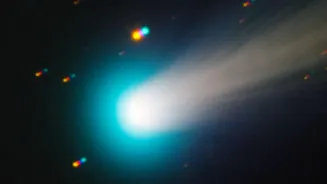
The real excitement for scientists lies in a comet's composition. Comets are often called 'dirty snowballs'—ancient chunks of ice, dust, and frozen gases left over from the formation of a planetary system. Studying a comet from our own solar system tells us about our own cosmic history. But studying an interstellar comet is like receiving a package from another star system, giving us a direct sample of the materials that form planets elsewhere. Early observations of 3I/ATLAS showed that it was 'active', meaning it was shedding gas and dust to form a fuzzy cloud called a coma, confirming it was a comet. Analysis of this gas revealed a chemical cocktail unlike that of most comets from our system, with unusually high levels of carbon monoxide and other isotopes.
What Its Composition Reveals
The specific chemical signature of 3I/ATLAS offers tantalizing clues about its birthplace. For instance, the second interstellar visitor, 2I/Borisov, was found to be very rich in carbon monoxide, suggesting it formed in a very cold environment, possibly around a smaller, cooler star than our Sun. Similarly, the chemistry of 3I/ATLAS, including its high ratio of certain carbon isotopes, suggests it may have formed in an extremely cold region that had not been heavily seeded with elements from many generations of stars. Some studies have even suggested this could make 3I/ATLAS incredibly old, perhaps as old as 11 billion years, originating from a star in an older part of our Milky Way galaxy. While its exact home star remains unknown, studying its makeup helps us understand the diversity of planetary building blocks across the galaxy.
The Future of Interstellar Science
For decades, the existence of interstellar objects was just a theory. Now, thanks to powerful new telescopes like the ATLAS survey and others, we are beginning to spot them. Each discovery provides a rare opportunity to study a piece of another solar system up close. While 'Oumuamua was a fleeting and mysterious asteroid, the cometary nature of 2I/Borisov and 3I/ATLAS has allowed for much more detailed analysis of the gases they release. Scientists expect that as our detection capabilities improve, we will find many more of these interstellar messengers, turning these rare events into a regular stream of data that will revolutionize our understanding of how planetary systems, including our own, are built.