





The Gravity Giants
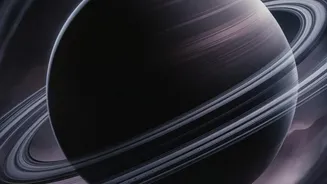
The story of planetary rings begins with immense size. Jupiter, Saturn, Uranus, and Neptune are fundamentally different from rocky inner planets like Earth. They are gas giants, containing dozens or even hundreds of times the mass of our own world. This
incredible mass generates a correspondingly powerful gravitational field. Gravity is the ultimate collector in the cosmos; the stronger the pull, the more effectively a planet can capture passing objects like comets and asteroids, and the more forcefully it can hold onto its own moons and any debris that forms around it. This gravitational dominance is the first and most crucial ingredient in building and keeping a ring system. Without it, the countless particles that make up a ring would simply drift away into space.
A Cosmic Danger Zone
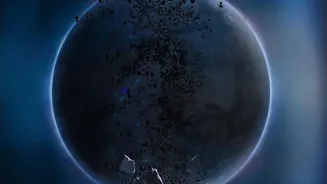
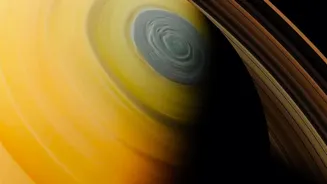
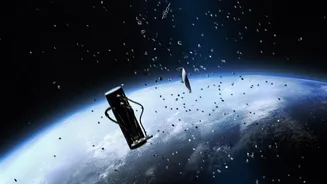
A planet's powerful gravity creates a 'no-go zone' for large objects known as the Roche limit. Imagine a moon or a comet straying too close to a giant like Saturn. The planet's gravity pulls more strongly on the near side of the object than on the far side. Once it crosses the Roche limit, this tidal force becomes so powerful that it overcomes the object's own gravity holding it together. The result is catastrophic: the object is torn to shreds, disintegrating into millions of smaller pieces of rock and ice. This destructive power is also creative; it’s one of the primary ways the raw materials for rings are generated. Instead of a single moon, the planet is now orbited by a massive cloud of debris, each piece a tiny moonlet in its own right.
Where Does The Debris Come From?
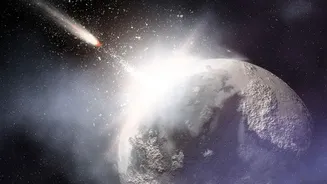
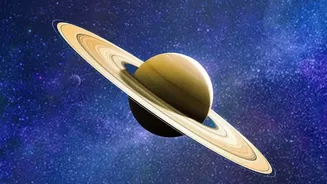
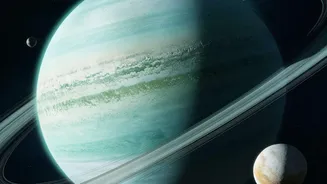
The debris disks around the outer planets are not all the same, and their origins can be complex and dramatic. The leading theory for many rings, including Saturn's, is the destruction of a celestial body. This could be a moon that wandered inside the Roche limit, or one that was shattered by a collision with a large comet or asteroid. In fact, some scientists believe Saturn’s brilliant rings are relatively young, perhaps only 100 million years old, and formed from the violent end of an icy moon. Other rings have different sources. Jupiter's faint, dusty rings are thought to be continuously supplied by dust kicked up from its small inner moons by micrometeorite impacts. The variety of sources helps explain why the ring systems look so different: Saturn’s are bright and made mostly of reflective water ice, while Uranus’s are dark and Jupiter's are faint and dusty.
Shepherd Moons: The Ringmasters
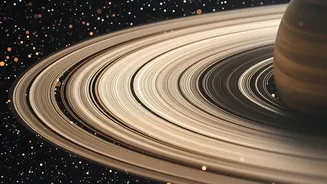
Once a ring of debris is formed, what stops it from spreading out and disappearing? The answer often lies with tiny 'shepherd moons'. These small moons orbit near the edges of a ring, or within gaps in the rings themselves. Their gravitational influence acts like a cosmic sheepdog herding a flock. A moon orbiting just outside a ring can gravitationally nudge particles that drift too far, pushing them back into line and keeping the ring's edge sharp. A pair of shepherd moons, one on either side of a narrow ring, can confine the particles between them, maintaining a tight, well-defined band. These moons are responsible for much of the intricate structure we see, creating the gaps, waves, and sharp edges that make the ring systems so complex and beautiful. Neptune's strange, clumpy ring arcs are also thought to be controlled by the gravitational pull of its moon Galatea.