


An Illusion We All Share
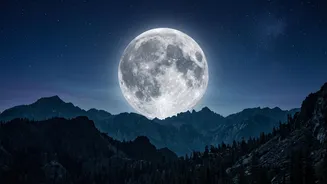
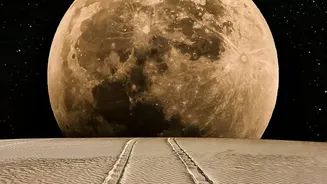
First, let's get one thing straight: the Moon Illusion is just that, an illusion. It's a phenomenon people have observed since ancient times, but it has nothing to do with the atmosphere acting like a lens or any physical change in the moon itself. In
fact, if you measure it, the moon is slightly smaller when it’s on the horizon because it's technically an extra Earth-radius farther away from you than when it’s directly overhead. You can prove it yourself. The next time you see a giant horizon moon, hold a small coin at arm's length until it just covers the lunar disk. Try it again a few hours later when the moon is high in the sky. The same coin will cover it perfectly, proving the moon's size never changed. The magic isn’t happening in the sky; it's happening inside your head.
Your Brain’s Faulty Logic
The entire illusion boils down to how our brains interpret visual information. We're wired to understand the world in three dimensions, using cues from our environment to judge size and distance. When an object is far away, it takes up less space in our field of vision. When it’s close, it takes up more. Our brains perform this calculation constantly without us ever noticing. But the moon breaks the rules. It’s so far away that it always has the same angular size (about half a degree), whether it's rising on the horizon or floating at its zenith. This consistency confuses our terrestrial-bound brains, which then rely on contextual clues to make sense of what they're seeing, leading to some fascinatingly wrong conclusions.
The Ponzo Illusion on a Cosmic Scale
One of the most powerful explanations for the Moon Illusion is a classic psychological trick called the Ponzo Illusion. Imagine two identical horizontal lines drawn between a pair of converging lines, like railroad tracks stretching into the distance. The line that appears 'farther' down the tracks will look longer, even though it’s the same length. Your brain, interpreting the converging lines as a sign of distance, automatically scales up the farther object. The same thing happens with the moon. When it’s on the horizon, it’s framed by trees, buildings, and mountains—all visual cues that your brain uses to perceive depth and distance. Placed against this detailed, 'distant' backdrop, your brain concludes the moon must be enormous. When the moon is high in the sky, it's surrounded by empty space, giving your brain no context to work with.
Apparent Distance and the Flattened Sky
Another key theory, known as the 'apparent distance hypothesis,' suggests we perceive the sky as a flattened dome, not a perfect hemisphere. To us, the sky directly overhead feels closer, while the sky at the horizon feels incredibly far away. This idea, first proposed by ancient observers, suggests that when we see the moon on the distant horizon, our brain registers it as being much farther away than the moon at its zenith. Since the moon on the horizon takes up the same amount of space on our retinas as the 'closer' overhead moon, our brain resolves this paradox by deciding the horizon moon must be physically larger. It's a compensation mechanism: if two things have the same retinal size but one seems farther away than one seems farther away than one seems farther away than one seems farther away than one seems farther away than one seems farther away than one seems farther away than one seems farther away than one seems farther away than one seems farther away than one seems farther away than one seems farther away than one seems farther away than one seems farther away than one seems farther away than one seems farther away than one seems farther away than one seems farther away than one seems farther away than one seems farther away than one seems farther away than one seems farther away than one seems farther away than one seems farther away than one seems farther away than one seems farther away than one seems farther away than one seems farther away than one sees.