







The Foundation: Perfecting Your Setup
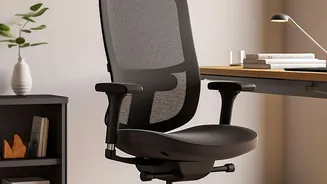
Good posture begins with a good environment. If your workspace is fighting you, you'll lose the battle before it starts. The goal is to create an ergonomic setup that supports the natural curves of your spine. Start with your chair. Adjust its height
so your feet are flat on the floor and your knees are at roughly a 90-degree angle. You should be able to sit back fully, ensuring your lower back is supported. Next, address your screen. Whether it’s a monitor or a laptop, it should be positioned directly in front of you at about an arm's length away. The top of the screen should be at or just below eye level to prevent you from tilting your head up or down. Finally, arrange your keyboard and mouse so your elbows can be at a 90-degree angle or slightly more open, with your wrists in a straight, neutral position. This prevents strain not just in your back, but in your shoulders, neck, and wrists as well.
The Rule of Motion: Embracing Variation
Even the most perfect, ergonomic posture becomes harmful if you hold it for too long. Our bodies are designed to move, and static positions lead to muscle fatigue, stiffness, and pain. Posture is not a static hold; it's a dynamic process. The key is to introduce regular variation into your day. The simplest way to do this is to take micro-breaks. Set a timer for every 30 to 60 minutes to stand up, walk around, and stretch. This small act of moving helps reset your posture, improve circulation, and prevent your postural muscles from becoming fatigued. If you have a sit-stand desk, use it. Alternate between sitting and standing throughout the day to change the load on your spine and engage different muscle groups. But variation isn't just about standing. It's about changing your position frequently. Even while seated, you can shift your weight, do small stretches, or adjust your chair's recline. The best posture is your next posture.
The Reset Button: Prioritising Recovery
Daily life, even with a great setup and frequent movement, can still create tension and imbalances. Recovery is the crucial third piece of the puzzle, helping to counteract the strain and actively improve your body's alignment over time. This involves both stretching tight muscles and strengthening weak ones. Stretches like the Cat-Cow, Child's Pose, and forward folds help lengthen and release tension in the spine, glutes, and neck. Simple neck stretches, where you gently tilt your head side to side, can alleviate strain from screen time. Strengthening exercises are equally important. A strong core provides essential support for your spine, making it easier to maintain good posture without conscious effort. Exercises like planks, bird-dog, and glute bridges build this foundational strength. Similarly, exercises that retract the shoulder blades, like rows or wall angels, help pull rounded shoulders back into proper alignment. Combining these helps your body not only find a better posture but also sustain it.