






The Small Satellite Revolution
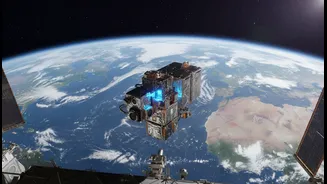
Welcome to the era of the CubeSat. These miniaturized satellites, often assembled from cost-effective, off-the-shelf components, are transforming space science. Originally developed for educational purposes, their modular, stackable design and lower launch
costs have opened the door for governments, universities, and private companies to participate in space exploration. Instead of one giant, costly satellite, scientists can now deploy constellations of these smaller counterparts, which can be built and launched in a fraction of the time. This new approach allows for more resilient and comprehensive data collection, as a fleet of small satellites can cover more ground and gather information more frequently than a single, large predecessor. This shift is democratizing access to space, enabling more rapid innovation and a wider range of missions.
A New Lens on Climate Change
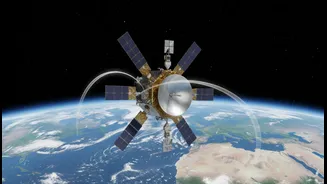
One of the most critical applications of this technology is NASA's PREFIRE mission. Short for Polar Radiant Energy in the Far-Infrared Experiment, this mission uses a pair of shoebox-sized CubeSats launched in May and June 2024 to study a crucial, yet poorly understood, aspect of our climate system. Earth regulates its temperature by absorbing heat in the tropics and radiating it back into space, primarily from the polar regions. A significant portion of this heat is released as far-infrared radiation, a type of energy that has never been systematically measured before. The PREFIRE satellites are the first to fill this critical knowledge gap, providing data that will drastically improve our climate models and help us better predict changes in weather, sea ice, and sea levels.
How It Improves Climate Models
The data from PREFIRE is a game-changer for climate scientists. Far-infrared emissions account for nearly 60% of the energy radiated from the Arctic, but our climate models have largely relied on estimations for this variable. By providing direct, concrete measurements, PREFIRE anchors these models in observed reality. This allows for more accurate projections of how fast the Arctic is warming and how quickly sea ice is melting. For a nation like India, with its thousands of kilometers of coastline and reliance on the monsoon, more accurate climate predictions are invaluable for disaster preparedness, agricultural planning, and water resource management. Understanding how much heat is trapped by atmospheric water vapor and clouds—another key measurement from PREFIRE—is essential for refining our understanding of the greenhouse effect at the poles.
More Than Just Climate Monitoring
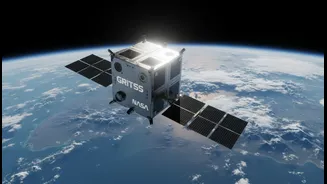
While the PREFIRE mission focuses on climate science, the CubeSat platform itself is incredibly versatile, addressing the other elements of the headline: navigation and mapping. For instance, NASA’s GRITSS mission, another suitcase-sized satellite launched in July 2026, aims to make global positioning more precise by creating a new link between different ground-based and space-based geodetic systems. Other small satellites are used for high-resolution Earth observation, helping to create detailed 3D maps, monitor deforestation, and track assets. These tiny orbital platforms can also serve as testbeds for new technologies, from advanced communication systems to autonomous navigation algorithms that use Earth's magnetic field as a guide.
The Future is Small and Powerful
The rise of the small satellite marks a fundamental shift in our approach to space. Missions that were once prohibitively expensive and took decades to plan are now becoming routine. This allows scientists to take more risks and test novel ideas that might not justify a billion-dollar budget. As technology continues to shrink, the capabilities of these compact craft will only grow. We are entering an era where constellations of hundreds, or even thousands, of small satellites will provide a real-time, high-definition view of our planet, from monitoring agricultural health to providing internet access in remote areas. These unassuming, suitcase-sized devices are not just additions to our space infrastructure; they are the foundation of its future, proving that in space, size isn't everything.