



Our Sky is a Time Machine
It sounds like science fiction, but it’s a fundamental reality of our universe. Light, while incredibly fast, does not travel instantaneously. It moves at a staggering speed of nearly 300,000 kilometres per second, a velocity so immense that it can circle
the Earth over seven times in a single second. Yet, the distances in space are so profoundly vast that even at this breakneck pace, the journey of light from the stars to us can take years, centuries, or even millennia. Astronomers use a unit called a 'light-year' to measure these cosmic distances. A light-year is simply the distance light travels in one year—a mind-boggling 9.46 trillion kilometres. So, when we say a star is 100 light-years away, it means the light we are seeing from it tonight began its journey 100 years ago. You are, quite literally, looking at the past. The night sky isn't a snapshot of the cosmos as it is 'now', but a composite image of what it looked like at thousands of different moments in history.
Messages from the Mughal Era
Let’s bring this idea closer to home. Look for Dhruva Tara, the Pole Star, a guiding light for travellers for millennia. This star is not a single point but a system, located approximately 433 light-years from Earth. The steady, pale-yellow light you see from it tonight didn't leave the star this evening. It began its journey around the year 1591. While the Mughal emperor Akbar was reigning over the Indian subcontinent, that very starlight was just beginning its long voyage across the void. Everything that has happened in our world since then—the rise and fall of empires, the industrial revolution, the entire modern era—occurred while that light was in transit. Even our closest stellar neighbours offer a glimpse into the recent past. Sirius, or Saptarshi, the brightest star in our night sky, is about 8.6 light-years away. The light from it that you see today is from late 2015. It’s a message from a time before many of the global events that have shaped our current world had even unfolded.
Watching a Star That May Already Be Dead
The concept gets even more dramatic with stars like Betelgeuse (Thiruvathirai/Ardra), the reddish star in the Orion constellation. Betelgeuse is a red supergiant, a star nearing the end of its life. It is destined to explode in a spectacular supernova, an event so bright it would be visible from Earth during the day. Astronomers say it could happen 'anytime' in the next 100,000 years. But here's the twist: Betelgeuse is about 640 light-years away. This means that if Betelgeuse exploded in the year 1384, we would only be receiving the 'news' of its death right now. For all we know, the star may have already self-destructed centuries ago. We are simply watching an echo, waiting for the final, cataclysmic light of its demise to complete its 640-year journey to our planet.
Looking Back to the Dawn of Humanity
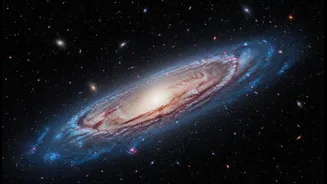
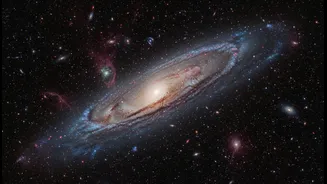
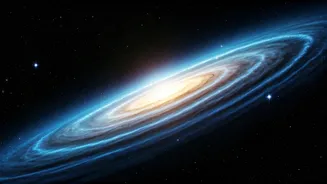
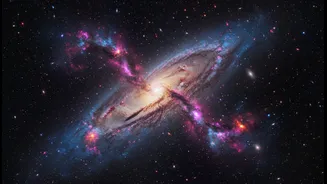
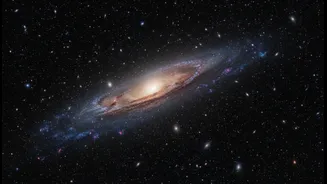
The scale of this cosmic time delay becomes truly humbling when we look beyond our own galaxy. On a very dark night, far from city lights, you might be able to spot a faint, fuzzy patch in the sky. This is the Andromeda Galaxy, our closest major galactic neighbour. That smudge of light is a collection of a trillion stars, and it is 2.5 million light-years away. The photons reaching your eyes from Andromeda tonight started their journey when our distant ancestors, early hominins like *Homo habilis*, were first walking the Earth. When that light began its trip, the concept of humanity was millions of years in the future. We are staring at a photograph of a galaxy as it was when our own evolution was in its infancy.