



A Frontier of Frozen Remnants
Beyond the orbit of Neptune lies a vast, doughnut-shaped region of space called the Kuiper Belt. This enormous realm is populated by millions of icy bodies, remnants from the formation of our solar system more than 4.5 billion years ago. Think of it as a cosmic
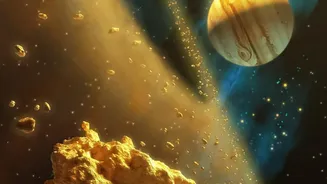
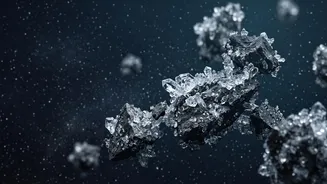
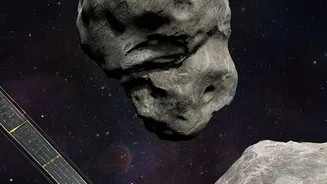
deep freeze, preserving the original building blocks of planets. These objects, known as Kuiper Belt Objects (KBOs), range from small, icy rocks to dwarf planets like Pluto. Occasionally, these objects collide, creating a fine cloud of dust. This dust, pushed by solar wind and pulled by gravity, slowly makes its way across the solar system, with some of it eventually raining down into Earth's upper atmosphere.
Why This Dust Is a Scientific Treasure
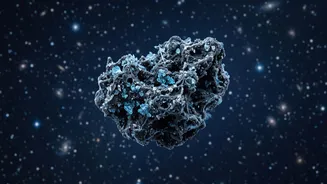
This isn't just any dust. Each microscopic particle is a time capsule, holding clues about the origins of our solar system. Because the Kuiper Belt is so cold and distant, the materials there have remained largely unchanged since the solar system was born. By studying this primordial dust, scientists can analyse the raw ingredients that formed the planets, including Earth. These particles can tell us about the chemical, mineralogical, and organic composition of the solar system's earliest days. It's like cosmic archaeology, allowing us to piece together our planetary history by examining the most basic materials that started it all.
Fishing for Stardust in the Stratosphere
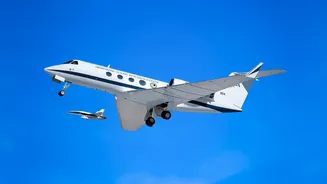
To collect these precious grains, NASA uses high-altitude research aircraft like the ER-2. Flying at altitudes around 20 kilometres (about 65,000 feet), these planes soar high above most of the Earth's weather and terrestrial dust, entering the thin, stable layer of the stratosphere. This altitude is crucial because it's where interplanetary dust particles tend to settle before becoming contaminated by the lower, dirtier layers of the atmosphere. The aircraft are equipped with specially designed collection instruments mounted in pods on their wings. These collectors are only opened once the plane reaches its cruising altitude, ensuring that they capture stratospheric particles with minimal contamination from the ground or lower atmosphere.
The Technology of Collection
The collection process is ingeniously simple yet effective. The collectors are essentially flat plates coated with a layer of sticky silicone oil. As the aircraft flies through the stratosphere, tiny interplanetary dust particles collide with these plates and get stuck in the oil, much like insects on flypaper. After a series of flights, accumulating many hours of exposure, the collectors are retracted into sealed containers, brought back to Earth, and transported to an ultra-clean laboratory at NASA's Johnson Space Center. There, scientists painstakingly examine the plates under powerful microscopes, locating, extracting, and cataloging each individual particle for study by the global scientific community.
What We Hope to Learn
This ongoing collection effort, which began back in 1981, has provided a steady stream of extraterrestrial material for analysis. One key goal is to link specific dust particles to their parent bodies, such as particular comets that originate in the Kuiper Belt. By collecting during known meteor showers (which occur when Earth passes through the debris trail of a comet), scientists can increase the chances of capturing material from a known source. Analysis of these grains helps us understand the diversity of materials in the outer solar system, how planets formed, and could even provide insights into how water and organic molecules—the building blocks of life—were delivered to the early Earth. Each tiny speck adds a new piece to the grand puzzle of our cosmic origins.