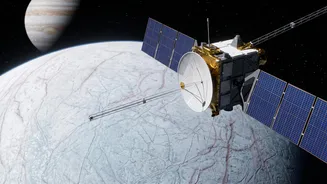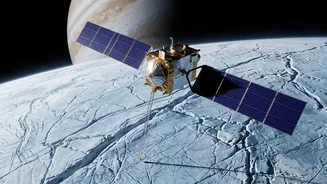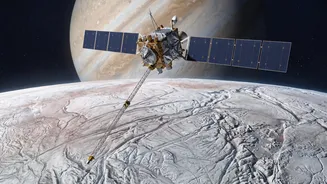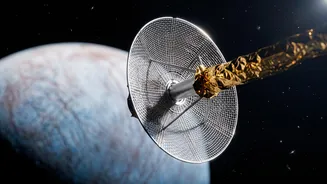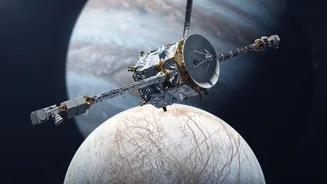





Far from Earth, a spacecraft is hurtling through the void on one of humanity's most exciting quests: to peer beneath the ice of a distant moon. NASA's Europa Clipper is on its way, and a recent, crucial test has just been declared a success.
The Promise of an Alien Ocean
For decades,
Jupiter's moon Europa has been a tantalizing subject for scientists. It is a world covered in a thick shell of water ice, but multiple lines of evidence from previous missions suggest that beneath this frozen crust lies a vast, global ocean of liquid saltwater. Where there is liquid water on Earth, there is life. This simple fact makes Europa one of the most promising places in our solar system to search for life beyond our own planet. The central mystery, however, has always been how to confirm the ocean's existence and character without drilling through kilometres of ice. The Europa Clipper mission, which launched in October 2024, is designed to do just that, and its key to unlocking this mystery is a sophisticated ice-penetrating radar.
REASON: The Eyes That See Through Ice
The instrument at the heart of the mission is called REASON, which stands for Radar for Europa Assessment and Sounding: Ocean to Near-surface. It is a powerful radar system designed to act like a planetary-scale X-ray, sending radio waves deep into Europa's icy shell. The technology was honed by scientists who use similar methods to study Antarctica's hidden subglacial lakes. By analyzing how these signals bounce back, scientists can map the ice shell's structure, measure its thickness—thought to be anywhere from 3 to 30 kilometres—and, most importantly, detect the boundary where ice meets liquid water. It can also spot potential pockets of water trapped within the ice, which could be conduits between the surface and the deep ocean. Essentially, REASON is the only instrument that can look directly for the ocean itself.
The Crucial Deep-Space Test
While the spacecraft is still years from its 2030 arrival at Jupiter, the mission recently passed a monumental milestone. During a flyby of Mars in March 2025, used to adjust its trajectory, the mission team activated REASON for a full-scale test in deep space—something impossible to do on Earth. For about 40 minutes, the instrument sent its signals toward the Martian surface and received the echoes perfectly. After months of analyzing the 60 gigabytes of data, NASA has now confirmed the test was a complete success. Don Blankenship, the instrument's principal investigator, stated, "We got everything out of the flyby that we dreamed." This update is what has captivated enthusiasts; it confirms that the mission's most critical tool works flawlessly and is ready for its main event.
A Long Journey and a Future Earth Flyby
The Europa Clipper's journey is a long and complex one. The Mars flyby was the first of two gravity assists needed to propel the massive spacecraft across its 2.9-billion-kilometre journey. The next major event on its itinerary is another gravity assist, this time using Earth's gravity in December 2026. This manoeuvre will give it the final boost it needs to reach the Jupiter system. The success of the REASON test during the Mars flyby provides immense confidence to the science and engineering teams as they prepare for this next step. It also gives them a head start on learning how to process the unique data the instrument will collect once it finally arrives at its mysterious destination.