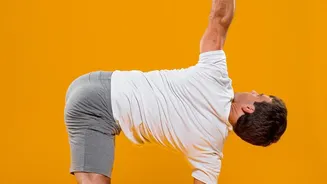





The standing torso twist is a staple in warm-up routines and fitness classes everywhere. But simply swinging your arms side to side may do more harm than good. The key to unlocking its real benefits lies in spinal awareness.
Why Spinal Anatomy Is Crucial
Before you twist, it helps
to understand your spine's design. Your spine isn't one uniform rod; it has different sections with different capabilities. Your lumbar spine, or lower back, is built for stability and has very little rotational ability—only about 10-15 degrees. Forcing it to twist can lead to disc issues and lower back pain. In contrast, your thoracic spine, the section connected to your rib cage, is designed for rotation. It can safely move about 35-40 degrees. The entire goal of a standing torso twist is to mobilize this mid-back region while keeping the lower back stable and protected. When you improve your awareness, you learn to isolate the movement in the thoracic spine, making the exercise both safer and more effective.
Common Mistakes to Avoid
Many people perform this movement on autopilot, which leads to several common errors. The most frequent mistake is generating the twist from the lower back and hips, often by using momentum and swinging the arms wildly. This puts dangerous torque on the lumbar vertebrae and sacroiliac (SI) joints. Another error is allowing your hips and pelvis to move with your shoulders. If your whole lower body sways with your upper body, you are not creating any spinal rotation; you are simply turning your entire torso as a single block. A proper twist requires separating the movement of your rib cage from your pelvis. Finally, forgetting to engage the core is a major misstep. A braced core acts like a natural corset, protecting your lower back from excessive, unwanted movement.
Build Your Twist from the Ground Up
A safe and effective twist starts with a solid foundation. Stand with your feet shoulder-width apart, with a slight bend in your knees. Your feet should feel firmly planted on the ground. The most critical part of your foundation is your pelvis. Before you even begin to rotate, ensure your hips are stable and facing directly forward. Imagine your hip bones are like headlights on a car, and they must continue to shine straight ahead throughout the movement. Placing your hands on your hips can provide tactile feedback to ensure they aren't swaying side to side as you twist. By locking in your lower body, you create the stable base needed to allow your upper body to rotate safely around it.
Techniques for Mindful Rotation
To perform a mindful twist, slow down and focus on quality, not quantity. First, stand tall and lengthen your spine, as if a string is pulling the crown of your head toward the ceiling. This creates space between your vertebrae. Place your arms across your chest or behind your head. Take a deep breath in. As you exhale, engage your core muscles and begin the twist, initiating the movement from your rib cage and mid-back. Think about turning your chest, not just your shoulders. The rotation should be slow and deliberate. Move only as far as you can without letting your hips follow or feeling any strain in your lower back. Your head and neck should be the last to turn, simply following the path of your thoracic spine. Inhale as you slowly return to the center and then repeat on the other side.
Drills to Enhance Body Awareness
If you struggle to feel the movement, several drills can help build proprioception, which is your sense of your body's position in space. Try performing the exercise in front of a mirror to watch your hips and ensure they remain stationary. Another effective technique is to place one hand on your rib cage and the other on your hip. As you twist, you should feel your rib cage moving while your hip stays still. You can also use visualization: picture your spine as a spiral staircase, with the rotation happening smoothly up the levels of your mid-back. Or imagine your torso is a wet towel that you are gently wringing out from the middle. These mental cues can dramatically improve your physical execution.