




What is a Lunar Sample Return Mission?
A sample return mission is one of the most complex feats in space exploration. While landing a craft on another celestial body is a huge achievement, a sample return mission involves landing, collecting materials, launching from that body's surface, journeying
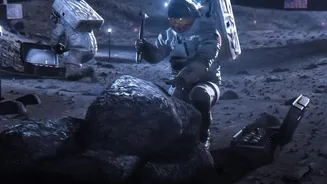
back to Earth, and safely re-entering the atmosphere. If successful, Chandrayaan-4 will make India only the fourth country to accomplish this, joining the ranks of the United States, the former Soviet Union, and China. The primary goal is to bring pristine lunar soil and rocks, known as regolith, back to Earth for detailed scientific analysis in advanced laboratories. This allows for a much deeper understanding than what can be achieved by robotic instruments on the lunar surface alone.
The Prime Target: Moon Soil Ice
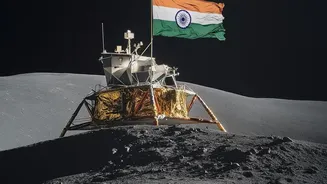
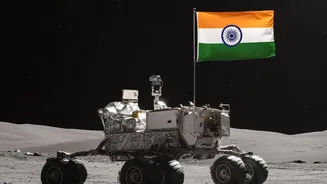
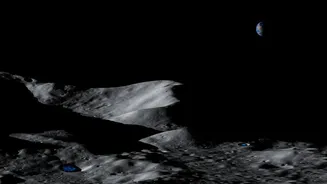
Chandrayaan-4 is not just collecting any soil; it has a specific target of immense scientific interest: water ice. The mission plans to land in the Moon's south polar region, the same area where Chandrayaan-3 made its historic touchdown. This region is believed to contain water ice in permanently shadowed craters, where sunlight never reaches. This ice is a potential treasure trove. Scientifically, it could hold clues about the history of the solar system and the origin of water on Earth. Practically, it's seen as a critical resource for future space exploration. This water could potentially be mined and converted into drinking water, breathable oxygen, and even rocket fuel, which would be essential for establishing a long-term human presence on the Moon.
An Ambitious Five-Part Strategy
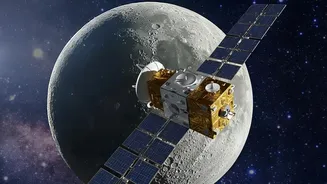
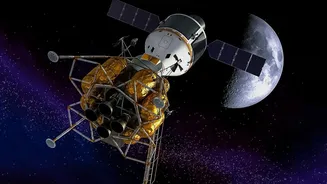
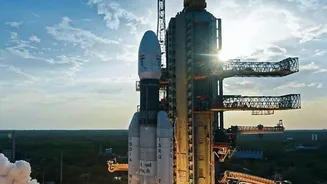
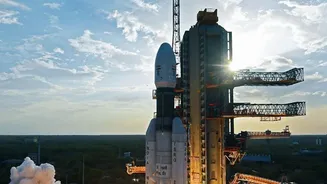
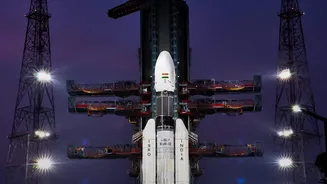
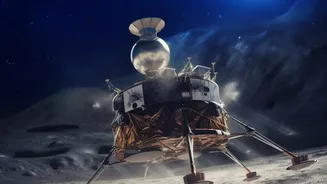
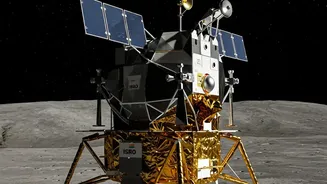
To achieve this goal, ISRO has devised a complex, multi-stage strategy. The mission will involve five separate modules: a Propulsion Module, a Descender Module (lander), an Ascender Module, a Transfer Module, and a Re-entry Module. Due to the combined weight, the mission will require two separate rocket launches using India's heaviest launcher, the LVM3. One launch will carry the lander and ascender, while the second will carry the modules responsible for the return journey. This plan involves several key maneuvers that ISRO will attempt for the first time, including launching a vehicle from the Moon's surface and performing autonomous docking in lunar orbit to transfer the precious cargo.
How the Mission Will Unfold
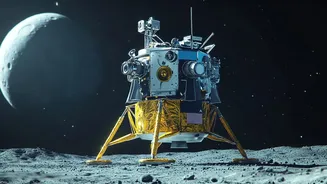
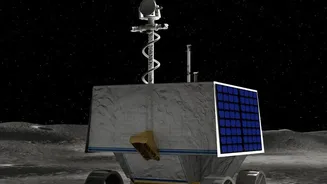
The mission is expected to unfold like a carefully choreographed deep-space ballet. After the two sets of modules reach lunar orbit, the Descender and Ascender will separate and make a soft landing. Once on the surface, a robotic arm and a drill on the lander will collect up to three kilograms of surface and sub-surface samples. These samples will be sealed in a container on the Ascender module. The Ascender will then launch from the lander, which acts as its launchpad, and rendezvous with the Transfer and Re-entry modules orbiting the Moon. After a robotic transfer of the sample container, the Re-entry module will begin its journey back, ultimately delivering the lunar material safely to Earth.
Paving the Way for India's Future in Space
Scheduled for launch around 2028, Chandrayaan-4 is more than just a scientific quest; it's a critical stepping stone for India's long-term space ambitions. The technologies developed for this mission—including orbital docking, robotic sample collection, and high-speed atmospheric re-entry—are crucial for future human spaceflight. Successfully completing this mission will not only provide invaluable scientific data but also demonstrate the end-to-end capability required to send Indian astronauts to the Moon by 2040, a goal set out by the government. It solidifies India's position as a major power in space exploration, building on its reputation for executing complex missions in a cost-effective manner.