






A Seed's High-Stakes Gamble
Every seed holds a universe of potential, but it faces a critical, life-or-death decision: when to germinate. Sprout too early, and a late frost or sudden drought could be fatal. Wait too long, and it might miss its window of opportunity, outcompeted
by other plants. This delicate balancing act has long fascinated scientists. For a seed, germination isn't just a matter of adding water. It’s a complex process governed by an internal checklist of environmental cues—light, temperature, and, crucially, the right amount of moisture. The seed is essentially a survivalist, packed with just enough fuel (the endosperm) to get started. It cannot afford to gamble recklessly. It needs assurance that conditions are favourable not just for a day, but for the foreseeable future.
The Protein That Hits the Brakes
To prevent a premature start, seeds employ a molecular 'brake' system. At the heart of this system is a protein called abscisic acid insensitive 5, or ABI5. Think of ABI5 as a strict gatekeeper. Its job is to suppress the genes that trigger germination, keeping the seed in a dormant state. As long as ABI5 levels are high, the seed remains asleep, patiently waiting for the perfect moment. This protein is sensitive to a plant hormone called abscisic acid (ABA), which is famously known as the 'stress hormone' in plants. High levels of ABA, often produced under dry and stressful conditions, keep the ABI5 gatekeeper on high alert, ensuring the seed does not sprout into a hostile environment. This mechanism is a brilliant evolutionary strategy for survival, ensuring the next generation doesn't begin its life in vain.
How Rain Washes Away the Doubt
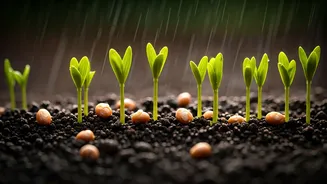
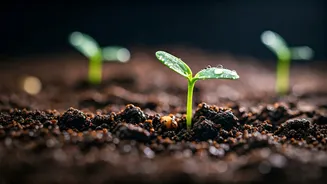
This is where the new discovery, led by scientists at the Gregor Mendel Institute of Molecular Plant Biology, changes our understanding. The headline, 'Rainy Soil Makes Seeds Feel Less Demanding,' perfectly captures the finding. Researchers found that when soil is wet, it releases chemical signals into the water. When a seed absorbs this 'soil water,' these signals trigger a process that actively destroys the ABI5 protein. In essence, the wet soil sends a clear message: 'The coast is clear. You have enough water to sustain yourself.' This causes the internal brake to be released. With the ABI5 gatekeeper gone, the germination genes are activated, and the seed begins to sprout. The seed becomes 'less demanding' because the most critical condition for survival—sustained water—has been met, allowing it to overlook other, less-than-perfect conditions.
A Clever Experiment in a Dish
To prove this, the scientists conducted an elegant experiment. They didn't just add pure water to seeds. Instead, they collected water that had already percolated through soil—what they called 'soil water extract.' They found that seeds placed in this extract germinated more readily than seeds placed in plain water, even under stressful conditions like high salt concentrations. This confirmed that the soil itself, when wet, was providing an additional, powerful pro-germination signal. The compounds in the soil water were actively helping the seed to break down its internal inhibitors, giving it the final push it needed to commit to growth.
From Lab to Farmland
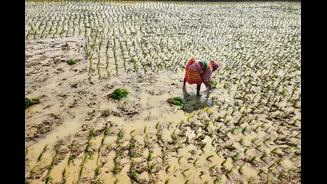
The implications of this discovery are significant, especially for a country like India, where agriculture is deeply intertwined with rainfall patterns and the monsoon. Understanding the precise signals that control germination could pave the way for new agricultural technologies. As climate change leads to more erratic weather, farmers face increasing uncertainty. If we can understand and potentially replicate the chemical signals that wet soil sends to seeds, we might be able to develop treatments that improve germination rates and ensure more uniform crop stands, even in challenging conditions. This could lead to 'seed priming' technologies that give crops a stronger, more reliable start, boosting food security in the face of a changing climate. It's a reminder that solutions to some of our biggest challenges may be hidden in the subtle chemistry of the soil beneath our feet.