

A New Shape in the Skies
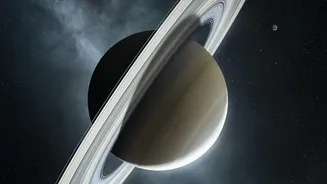
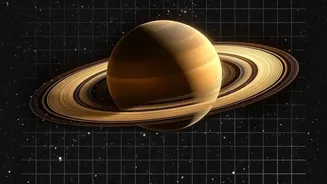
Scientists using the Hubble Space Telescope have confirmed the existence of a massive, 10-sided atmospheric wave, or decagon, encircling Saturn’s south pole. Announced in September 2026, this is the first time such a large, regular-sided jet pattern has
been seen in the planet’s southern hemisphere. The discovery came as a surprise; researchers have been searching for a southern counterpart to the northern hexagon since the 1990s without success. The Cassini spacecraft, which orbited Saturn from 2004 to 2017, saw no hint of this structure. It was only when Saturn’s seasonal tilt brought the south pole back into view from Earth in 2023 that faint signs of the decagon began to emerge in Hubble images.
The Famous Northern Hexagon
To understand why the decagon is so significant, you have to know about its famous sibling. Saturn’s north pole is home to a massive, stable hexagon, first spotted by the Voyager spacecraft in the 1980s. This six-sided jet stream is wider than two Earths and has been spinning steadily for more than 40 years. It’s a remarkably persistent feature of the gas giant’s weather. For a long time, scientists thought it might be a complete anomaly—a one-of-a-kind feature in the solar system. The sudden appearance of a southern polygon, albeit with ten sides instead of six, suggests these geometric storms might be a more fundamental aspect of Saturn’s atmospheric behaviour than previously thought.
The Science of Planetary Polygons
So, how does a planet's atmosphere form a near-perfect geometric shape? The answer lies in its jet streams. On giant, fast-spinning planets like Saturn, powerful winds flow in bands at different speeds. Scientists believe that instabilities in these powerful jet streams can create standing waves—similar to the way a vibrating string can form a stable wave pattern. Laboratory experiments using rotating tanks of liquid have shown that when fluids at the center and edge of the tank rotate at different speeds, polygonal shapes can naturally form at the boundary. The number of sides—whether six or ten—depends on the specific properties of the wind shear and atmospheric conditions. These are not just surface-level patterns; observations show both the hexagon and the new decagon are deep, three-dimensional structures that extend far down into the atmosphere.
Why a Decagon, and Why Now?
The timing of the decagon’s appearance is the most exciting part for scientists. Unlike the long-lived northern hexagon, the southern decagon appears to be brand new and is still evolving. Hubble images show it becoming stronger and more defined between 2023 and 2025. The leading theory for its sudden formation is tied to Saturn's long seasons. A year on Saturn lasts for about 29 Earth years. The planet’s southern hemisphere has been moving into its summer, bathing the pole in constant sunlight since the equinox in 2009. This increased solar energy is likely changing the atmospheric dynamics, creating the right conditions for the jet stream instability to form the 10-sided wave. It gives researchers a rare opportunity to watch a giant planetary weather system being born.
An Evolving Mystery
The discovery of the decagon has turned Saturn into a fascinating natural laboratory for planetary atmospheres. While the northern hexagon is a picture of stability, the southern decagon is a dynamic, changing feature whose future is unknown. Scientists wonder if it will stabilize and persist for decades like its northern counterpart, or if it's a more temporary phenomenon that will eventually break apart. Continued observations with the Hubble and James Webb Space Telescopes will be crucial. By watching how this 10-sided pattern behaves in the coming years, scientists hope to solve the broader puzzle of how and why these incredible geometric storms form on the gas giants of our solar system.