




More Than Just Clothes
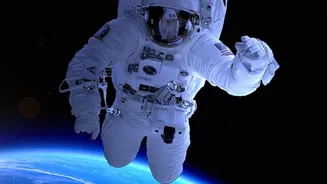
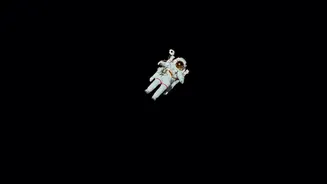
It’s best to think of a spacesuit not as clothing, but as a small, human-shaped spacecraft. Known formally as an Extravehicular Mobility Unit or EMU, it provides everything a human body needs to survive where there is no air, no pressure, and wild temperature
swings. Without it, an astronaut would lose consciousness in about 15 seconds. The modern EMU weighs over 140 kg on Earth and consists of multiple complex components, including the suit itself and a backpack called the Primary Life Support System (PLSS), which handles life support and communications.
Fighting the Void: The Need for Pressure
Space is a near-perfect vacuum. On Earth, the atmosphere provides a constant pressure of about 101 kPa (14.7 psi) at sea level, which our bodies are adapted to. Without this external pressure, the gases dissolved in our bodily fluids would vaporise, a process called ebullism. To counteract this, a spacesuit maintains an internal pressurised atmosphere. The EMU is pressurised with pure oxygen to about 4.3 psi, roughly one-third of Earth's atmospheric pressure. This is enough to keep body fluids stable while allowing for greater flexibility than a higher-pressure suit would.
A Breath of Fresh Air in a Vacuum
The PLSS backpack is the astronaut’s lifeline. It contains tanks of high-pressure oxygen for breathing. A fan circulates this oxygen through the helmet and suit. As the astronaut exhales, the suit must also remove the carbon dioxide they produce. This is done using a system that scrubs the CO2 from the air, which is then recycled back into the breathing loop. The backpack also holds a water supply for an in-suit drink bag, batteries to power all the electronic systems, and a radio for communication with the station and Mission Control.
Surviving Extreme Temperatures
In direct sunlight, a spacewalker can face temperatures of 121°C, while in shadow it can plummet to -157°C. The suit’s outer layers are white to reflect as much solar radiation as possible. However, the real challenge is removing the heat generated by the astronaut's own body. To manage this, astronauts wear a Liquid Cooling and Ventilation Garment underneath the main suit. This garment, which resembles long underwear, has a network of about 300 feet of thin tubes woven into it. Chilled water circulates through these tubes, absorbing body heat, and then returns to the PLSS backpack to be cooled again before being recirculated.
A Shield Against Invisible Dangers
A spacesuit is made of many layers—up to 16 in some parts. The outer layers form a Thermal Micrometeoroid Garment, built from rugged, puncture-resistant materials like Kevlar and Nomex. This shell is designed to protect the astronaut from impacts by tiny, fast-moving particles of dust and debris that could otherwise pierce the suit. These layers also provide shielding from harmful solar and cosmic radiation. The helmet's visor has a special gold coating that is thin enough to see through but effective at reflecting dangerous ultraviolet and infrared radiation, acting like a super-powered pair of sunglasses.
The Future of Spacewear
While the current EMU has been a workhorse on the International Space Station, new suits are being developed for future missions to the Moon and Mars. Companies like Axiom Space are building the next generation, called the AxEMU, for NASA's Artemis missions. These new suits promise greater mobility and flexibility, allowing astronauts to walk, bend, and handle tools more naturally on a planetary surface. They are being designed to fit a wider range of body types and withstand the harsh, dusty environment of the lunar south pole.