
What Am I Looking For?
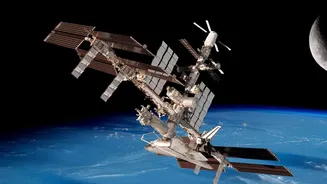
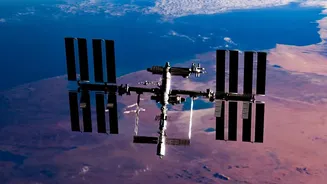
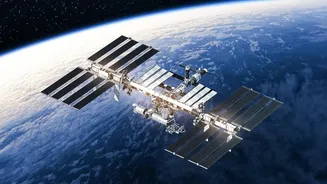
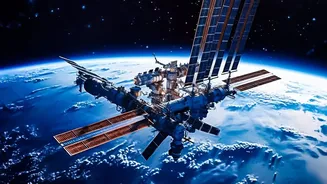
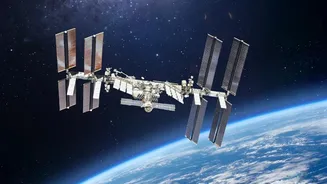
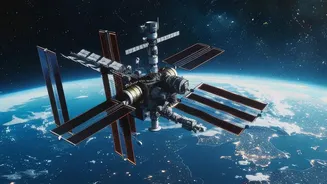
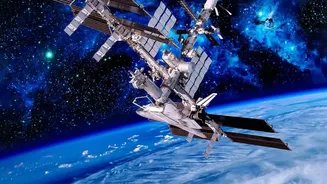
Forget what you know about planes. The ISS appears as a very bright, steady point of light moving quickly across the sky. It looks like a fast-moving star and does not have the flashing or blinking lights characteristic of an airplane. Because it travels
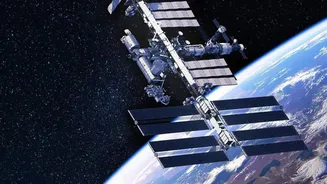
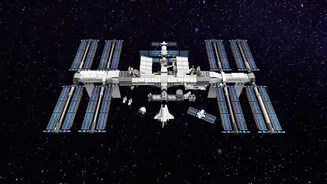
at a staggering 28,000 km/h, it will cross your field of view in just a few minutes. Its brightness comes from its massive solar arrays reflecting sunlight back to us on the ground. In fact, at its brightest, it can be more brilliant than any star or planet in the sky, outshone only by the Sun and the Moon. This makes it visible even from light-polluted city centres.
The Best Time to Look
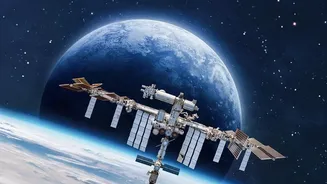
The key to seeing the ISS is timing. You can only see it when it is flying through sunlight, but the sky where you are is dark. This creates a specific viewing window: the first couple of hours after sunset and the last couple of hours before sunrise. During these twilight periods, the station, orbiting about 400 kilometres high, is still bathed in sunlight while you are in darkness, allowing it to shine brightly against the dimming or pre-dawn sky. If you look in the middle of the night, the station will be in Earth's shadow and thus invisible. A single pass can last anywhere from less than two minutes to nearly eight minutes for a full horizon-to-horizon flyover.
How to Find Sighting Times for Your City
The ISS orbits the Earth about 16 times a day, but its path covers different parts of the globe on each pass. To know exactly when it will be visible from your specific location in India, you need a reliable tool. The best resource is NASA's official Spot The Station service. By visiting the website, you can select India and then choose your nearest city from a dropdown menu. The site will then generate a list of all upcoming viewing opportunities, complete with the exact local time the pass will start, how long it will be visible, its maximum height above the horizon, and the compass directions for where it will appear and disappear. For a more interactive experience, NASA also offers a free Spot The Station app for both iOS and Android devices, which can send you notifications ahead of a sighting.
Other Essential Tools and Apps
Beyond NASA's official tool, several other excellent resources can help you become an expert ISS spotter. The Heavens-Above website and app are long-standing favourites among astronomers and hobbyists, providing detailed charts and predictions for the ISS and other satellites. Other popular apps include ISS Detector, which has a very user-friendly interface, and Satellite Tracker by Star Walk. Many of these apps also feature real-time maps showing the station's current location over Earth and some even have an augmented reality (AR) feature. This allows you to hold your phone up to the sky, and the app will show you the exact path the station will take, making it almost impossible to miss.
A Checklist for a Perfect Sighting
Once you have your viewing time, you're almost ready. First, try to find a spot with a clear view of the sky, away from tall buildings or trees that might obstruct the pass, especially if the maximum elevation is low. Second, give your eyes a few minutes to adjust to the darkness; this will make the station appear much brighter. Third, know your directions. The sighting data will tell you where to look, for example, 'Appears: WSW, Disappears: NE'. Knowing your cardinal directions is crucial. Finally, be on time. The viewing windows are precise and last only a few minutes. Arrive a few minutes early so you don't miss the start of the pass. No telescope or binoculars are needed; the ISS is best enjoyed with the naked eye.