

A Faint Smudge of Immense Scale
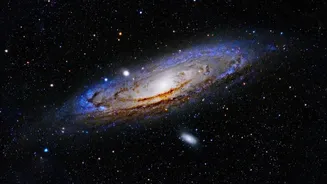
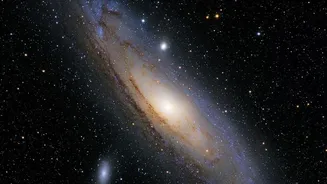
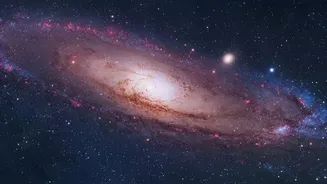
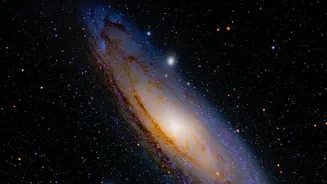
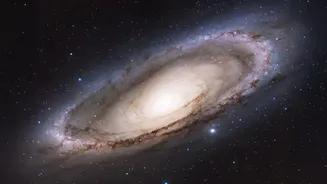
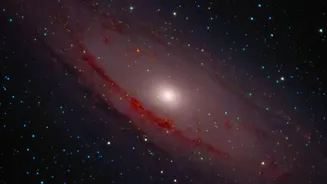
The first time a young stargazer points their binoculars to the right patch of a dark, moonless sky, they won't see the glittering spiral from science textbooks. Instead, they'll find a small, fuzzy, oval-shaped cloud of faint light. This smudge is the Andromeda
galaxy, or M31, and its understated appearance is precisely what makes the experience so powerful. It’s not a picture on a screen; it’s the real thing. That faint glow is the combined light from an estimated one trillion stars. Realising that this subtle patch is a galaxy far larger than our own Milky Way, containing countless suns and potential worlds, is a humbling lesson in cosmic scale. For a child, it transforms the abstract concept of a 'galaxy' into a tangible, visible object.
The Thrill of the Celestial Hunt
Finding Andromeda is an adventure in itself. The process, known as star-hopping, teaches patience and pattern recognition. From India and across the Northern Hemisphere, the easiest way is to first locate the distinctive 'W' shape of the constellation Cassiopeia. One of the 'V' shapes in the 'W' acts like an arrow that points in the general direction of Andromeda. Alternatively, you can use the Great Square of Pegasus, finding the star Alpheratz and hopping over to another star called Mirach, which then guides you toward the galaxy. This celestial treasure hunt is an engaging challenge. The moment of discovery, when the faint smudge slides into view, delivers a jolt of excitement and a genuine sense of accomplishment, proving that with a little knowledge, anyone can navigate the stars.
Looking Back Millions of Years in Time
Here is where the true wonder sets in. The Andromeda galaxy is about 2.5 million light-years away from Earth. This means the faint light reaching your eyes and entering your binoculars tonight began its journey 2.5 million years ago. Dinosaurs were long gone, but early human ancestors were just beginning to walk the Earth. In that moment, the child isn't just looking across space; they are looking back in time. This single observation is a practical demonstration of the finite speed of light, a concept that can be difficult to grasp in a classroom. It provides a direct, personal connection to the immense timescales of the universe, sparking profound questions about time, distance, and our own place in history. It is the most distant object the human eye can see without aid, a record held in a child's own gaze.
Our Galactic Neighbour and Future
Andromeda is more than just a distant marvel; it is our closest large galactic neighbour. Our Milky Way and Andromeda are the two biggest members of our local patch of the universe, called the Local Group. But this neighbour is on a collision course with us. Pulled together by gravity, the two galaxies are hurtling towards each other at about 110 kilometres per second and are predicted to merge in about 4.5 billion years. This future galactic dance, which will eventually form a new, giant elliptical galaxy, adds a dramatic narrative to the observation. For a young observer, knowing they are looking at a galaxy that will one day merge with our own transforms the view from a static picture into a dynamic story of cosmic evolution, a story in which our solar system will have a front-row seat.