

Meet NASA's Next Great Observatory
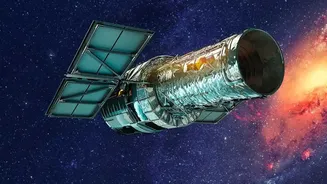
Scheduled for launch on August 30, 2026, aboard a SpaceX Falcon Heavy rocket, the Nancy Grace Roman Space Telescope represents a new era in astrophysics. Named after NASA's first Chief of Astronomy, a visionary who championed space-based observatories
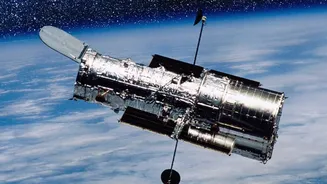
and is known as the “Mother of Hubble,” the Roman mission is set to expand on the legacies of its famous predecessors. It carries a primary mirror 2.4 meters in diameter, the same size as Hubble's, but its capabilities are engineered for a completely different kind of discovery. While telescopes like Hubble and Webb provide deep, narrow glimpses into cosmic history, Roman is designed to create vast, panoramic portraits of the universe.
A Universe in Panoramic View
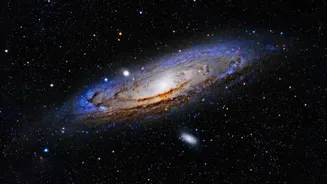
Roman’s greatest strength is its Wide Field Instrument, a 300-megapixel camera that gives it a field of view at least 100 times larger than that of the Hubble Space Telescope. This immense celestial real estate means that in just two snapshots, Roman can capture a mosaic of the Andromeda galaxy that would have required over 400 individual Hubble observations. This incredible survey speed will allow it to map billions of galaxies and stars over its five-year primary mission. It’s the difference between studying a single tree and mapping the entire forest. This broad perspective is crucial for tackling two of the biggest puzzles in modern cosmology: dark energy and the census of exoplanets.
Hunting the Ghost of the Cosmos: Dark Energy
One of Roman’s key objectives is to investigate dark energy, the mysterious force believed to be causing the accelerating expansion of the universe. Scientists know it makes up about 68% of the universe, but its nature remains unknown. Roman will tackle this enigma in several ways. It will conduct a massive survey of over a billion galaxies to map the structure of the cosmos, observing how galaxies have clustered over billions of years under the influence of dark energy and dark matter. It will also detect thousands of Type Ia supernovae, a specific kind of stellar explosion that serves as a 'standard candle' for measuring cosmic distances with high precision, allowing astronomers to chart the expansion history of the universe.
Finding New Worlds with a Gravitational Trick
Beyond studying the grand scale of the universe, Roman will conduct a revolutionary search for planets outside our solar system. While missions like Kepler looked for the dimming of starlight as planets passed in front of their stars, Roman will primarily use a technique called gravitational microlensing. This method detects the warping of spacetime caused by a star and its planets. When they pass in front of a more distant star, their gravity acts like a lens, momentarily magnifying the background star's light. This technique is sensitive enough to find planets with masses as low as Mars, and even free-floating 'rogue' planets that don't orbit a star at all. Scientists predict Roman could discover thousands of exoplanets, creating a statistical census of worlds in the cold, outer regions of planetary systems.
A Complement to Webb, Not a Competitor
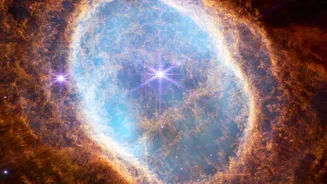
With its recent launch, the James Webb Space Telescope has captured the world’s imagination with its stunningly deep infrared images. So, where does Roman fit in? The two observatories are designed as powerful complements. Webb is a specialist, using its giant mirror and ultracold instruments to peer with extreme sensitivity into the farthest reaches of cosmic time. Roman, by contrast, is a wide-angle surveyor. It will rapidly scan the sky to identify targets of interest and analyze large-scale cosmic structures. In essence, Roman will find the 'wheres' and 'how manys,' creating catalogues of cosmic objects—from exoplanets to distant galaxies—that Webb and other telescopes can then study in greater detail.